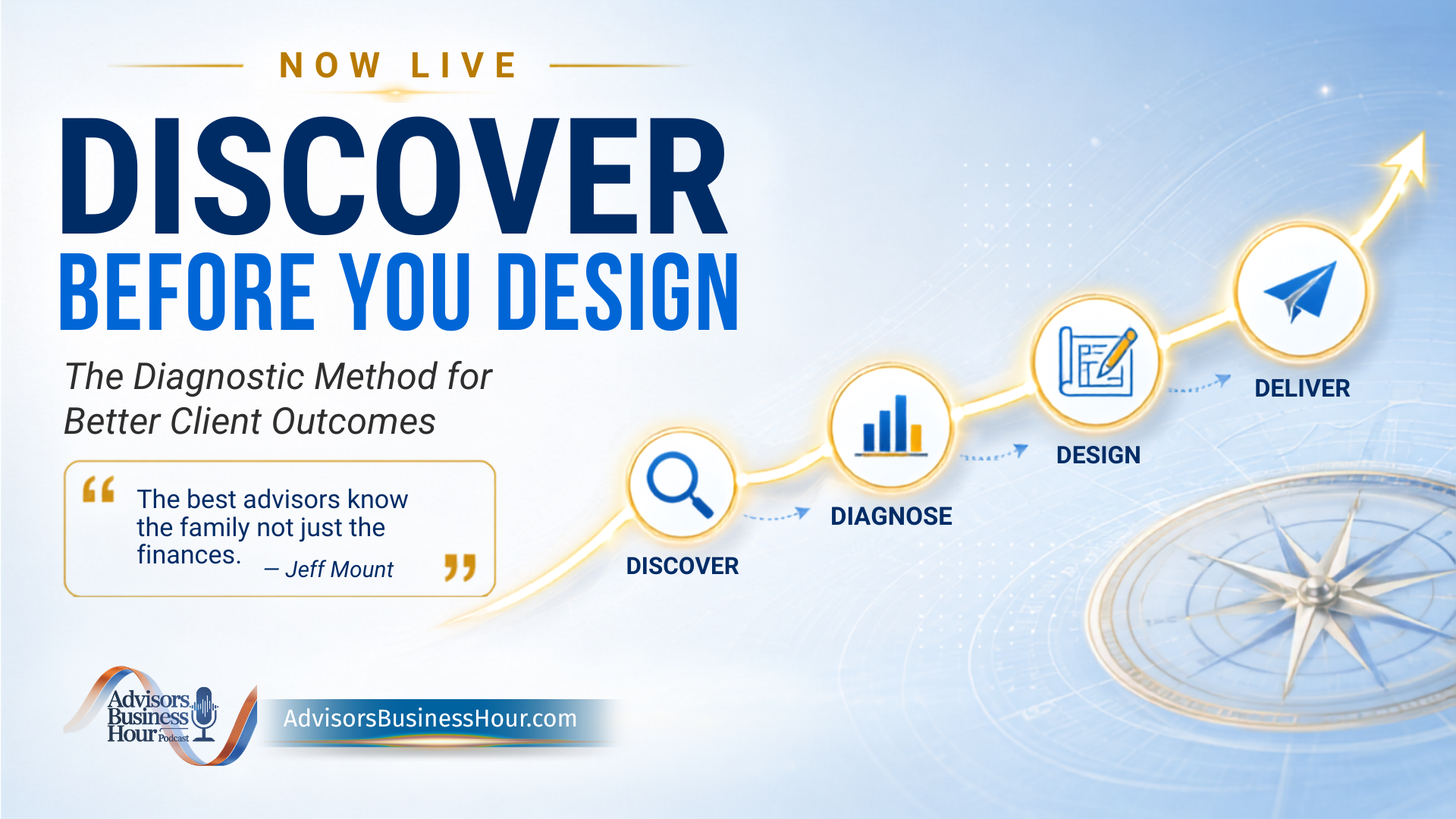
In this episode of The Advisors Business Hour, Jeff Mount and Sherry Sarver-Johnson explore the Diagnostic Method, a simple but powerful framework that helps advisors uncover what truly matters to prospects before designing recommendations. Inspired by the work of sales expert Jeff Thull, this approach focuses on understanding goals, challenges, family dynamics, and emotional motivations before presenting solutions.
The result? Better conversations, stronger trust, and more meaningful client relationships.
Why the Diagnostic Method Matters
Many advisors feel pressure to demonstrate expertise immediately. As a result, they often spend more time presenting solutions than understanding the client’s situation.
The Diagnostic Method reverses that process.
Instead of leading with recommendations, advisors first seek to understand:
- The client’s current situation
- Financial and personal challenges
- Long-term goals
- Family dynamics
- Emotional concerns behind financial decisions
By slowing down and asking better questions, advisors gain the context needed to deliver recommendations that truly fit the client’s needs.
The Four Stages of the Diagnostic Method
1. Discover
Discovery is the foundation of the entire process.
Jeff recommends spending nearly half of prospect meetings gathering information and understanding what matters most to the client.
Key discovery areas include:
- Financial goals
- Current investments
- Tax concerns
- Risk management issues
- Family relationships
- Children’s future plans
- Personal concerns and aspirations
The objective isn’t simply collecting data. It’s uncovering the emotional drivers behind financial decisions.
Questions should remain open-ended and encourage meaningful conversation.
2. Diagnose
Once information has been gathered, advisors must objectively evaluate the client’s current situation.
This is where many advisors make mistakes.
Instead of criticizing previous advisors or existing investments, Jeff recommends focusing on facts and outcomes.
A proper diagnosis answers questions such as:
- Is the current strategy aligned with the client’s goals?
- Are there gaps in protection?
- Are investments appropriate for the timeline?
- Are there opportunities being overlooked?
The focus should remain on solving problems rather than assigning blame.
3. Design
Design is where recommendations begin to take shape.
However, Jeff emphasizes that advisors shouldn’t disappear, create a plan, and return with a finished product.
Instead, clients should be involved throughout the process.
As ideas are developed, advisors should continually ask:
- Does this align with your expectations?
- Does this solve the problem we’re trying to address?
- Does the value justify the cost?
- Is this approach comfortable for you?
Collaboration creates ownership and increases client confidence in the proposed solution.
4. Deliver
Many advisors view delivery as the final step.
Jeff views it as the beginning of an ongoing relationship.
Markets change.
Families change.
Goals evolve.
Regular reviews allow advisors to:
- Measure progress
- Adjust strategies
- Address concerns early
- Reinforce trust
- Maintain alignment with long-term objectives
Successful delivery isn’t about presenting a plan.
It’s about continuously helping clients navigate change.
The Real Skill That Separates Great Advisors
According to Jeff, the most effective advisors learn how to “peel back the onion.”
They move beyond basic financial questions and uncover the deeper motivations behind client goals.
For example:
Instead of asking:
How much have you saved for college?
Ask:
Tell me about your children. What are their dreams? What do you hope to provide for them?
The second question reveals far more than the first.
It transforms a financial discussion into a meaningful human conversation.
Why Family Conversations Matter
One of the strongest themes throughout the episode is the importance of understanding the entire family.
Many advisors know their clients well but know very little about their children.
That can become a major problem when wealth transfers occur.
By building relationships across generations, advisors can:
- Strengthen trust
- Better understand family goals
- Improve continuity of service
- Create long-term business sustainability
The families who feel understood are more likely to remain engaged for years to come.
From Transactions to Trusted Relationships
The Diagnostic Method helps advisors move beyond transactional interactions and become trusted partners.
By focusing on discovery first, advisors gain deeper insights into client needs and can deliver recommendations that are both financially sound and emotionally relevant.
The framework is simple:
Discover. Diagnose. Design. Deliver.
Yet when applied consistently, it can transform the quality of advisor-client conversations and create stronger relationships built on trust, understanding, and collaboration.
Executive Overview
In this episode, Jeff Mount introduces advisors to the Diagnostic Method, a four-step framework that prioritizes understanding before recommending. The discussion explores how advisors can improve discovery conversations, objectively diagnose client situations, collaborate on solutions, and maintain trust through ongoing reviews. The episode also highlights the importance of emotional intelligence, family dynamics, and multigenerational relationship building in today’s advisory environment.
Timestamps
00:00 – Introduction to the Diagnostic Method
02:00 – Why discovery is the most important stage
05:00 – Making financial concepts tangible
09:00 – Understanding compounding and visualization
11:00 – Diagnosing without criticizing
13:00 – Designing solutions collaboratively
15:00 – The ongoing role of delivery
17:00 – Goals-based financial conversations
22:00 – Building trust through reviews
25:00 – Finding the question behind the question
27:00 – The power of multigenerational relationships
29:00 – Final thoughts and advisor takeaways
Key Takeaways
- Discovery should focus on both facts and emotions.
- Advisors should spend more time listening than presenting.
- Effective diagnosis is objective and non-judgmental.
- Clients should participate in the design process.
- Ongoing reviews are critical to maintaining trust.
- Emotional conversations often reveal the most valuable insights.
- Understanding family dynamics creates stronger client relationships.
- Building multigenerational connections can improve long-term retention.
- Better questions lead to better recommendations.
- Trust is built through understanding, not persuasion.
Transcript
[00:00:00] Sherry: Welcome back to the Advisor’s Business Hour, where we dive into the heart and hustle of building your ideal advisory practice. I’m Sherry Sarber-Johnson with Beneficial Business Solutions, and I’m here with my co-host, Jeff Mount, president of Cadis LLC.
[00:00:00] Sherry: And he’s also the guy affectionately known as the advisor to advisors. Welcome to the show, Jeff. Thanks, Sherry. So good to see you again. It’s always good to see you. And the, actually, the idea for today’s episode sprang from our discussion last month when you were breaking down your method of intriguing potential clients into setting up the first time meeting with your unique method, the verbal tennis method.
[00:01:00] Sherry: And you mentioned something which really perked up my ears while we were having that discussion called the diagnostic method. And I was hoping today that we could pick your brain and really kind of dive into that and how to do it properly and what’s involved and so forth. So let me give credit where credit is due.
[00:01:00] Jeff: I didn’t invent this, although verbal tennis I did. Um, Jeff Thull is the author of The Diagnostic Method, and, uh, I- I’ve taken all kinds of sales courses throughout the years. The thing that I love about this one is its simplicity. Um, you know, I’ve been through Miller Heiman, which is very complex, and it’s meant for enterprise sales, and it’s good, but if you don’t remember it, you don’t use it.
[00:01:00] Jeff: If you don’t use it, then it’s wasted time. So what’s the point? Yeah. Exactly. Uh, what I love about this is it’s really easy to remember. It’s easy to execute, but it’s also easy to, as we talked about last time, bite the marshmallow, which you don’t wanna do. Uh, take your time and, and follow the process completely.
[00:02:00] Sherry: Yeah, I really like what you said about it being a, you know, very practical framework- Yes … where advisors could build trust and they could find what really matters to their prospect and all of that. So why don’t we just take it from the top, and what’s the first step in the diagnostic method? So the first step is the discovery process.
[00:02:00] Jeff: Now, I think almost- Okay … every sales m- training I’ve ever seen, gone through, taught, whatever, starts with a discovery process. But that said, I don’t think enough people put enough time, energy, and effort into the discovery process. Again, ’cause they’re, they’re, they’re looking at that marshmallow and thinking, “I really wanna bite that thing.”
[00:03:00] Jeff: So asking questions, uh, open-ended questions, ’cause you wanna get them talking, asking questions about their current situation, what challenges are they facing specifically in financial, legal, tax, uh, um, risk management, what are the things that concern them and keep them up at night, what opportunities are they thinking about that they haven’t shared with you.
[00:03:00] Jeff: And then more, mo- probably more importantly anything, get into the family dynamic. You know, like- Okay … there’s so many advisors I talk to who know the husband and the wife really well But they don’t know the names of the kids. They know the kids exist- Mm-hmm … but they don’t know the names of the kids, they don’t know how old they are, they don’t know what they’re dealing with in life, what are the kids’ ambitions, what are the parents’ ambitions for the kids?
[00:04:00] Jeff: Is there a challenge here? Sometimes- Mm-hmm … there’s a, a child with a drug problem, uh, or, or worse. You know, certainly we came out of COVID and we know that depression was a big, big problem. Oh, yeah. Oh, yeah. And kids were affected the most, right? Yeah. So, uh, digging into these sensitive topics is really, really important in terms of building trust so that when you ultimately make a recommendation, and that recommendation may not necessarily be financial, it may be something else, they know that you’re doing so with their best interest at heart.
[00:04:00] Jeff: Um, asking questions and then diving deeper, peel that onion back a little farther. Mm-hmm. “Okay, if you haven’t done this so far, what consequences are you wrestling with right now?” Yeah. “What consequences might occur in the future?” Mm-hmm. “And should we go in a different direction?” Yeah. Again, all questions.
[00:05:00] Jeff: You’re not teaching, you’re not s- you’re not stating anything, you’re just getting to know these people. You know, I think one of the, the issues when it comes to think- talking about finances is going from an abstract conversation to something that seems tangible. Mm-hmm. ‘Cause when you’re selling a car or you’re selling something that’s visual and, and it’s, it’s, you know, it’s in the 3D, you can touch it and feel it and so forth, so forth, that is a different type of conversation because it’s very visual and people can imagine themselves in, you know, driving the car, for example, or living in a house or whatever.
[00:05:00] Sherry: Mm-hmm. Do you have any way that, you know, like any special tips that you use during that discovery method to create the sort of air of tangibility around the topic so it’s… we’re not just talking things on a calculator, we’re talking stuff that translates into this person’s life, their lifestyle, their relationships, and so on?
[00:06:00] Jeff: You’re, you’re rubbing a little salt in the wound right now. Um, and I say that because in one of my past lives I actually, with my business partner, built this calculator that was visual. Mm-hmm. And it showed, uh, from the math that’s done in financial planning exactly what your metaphorical journey through life, sailing through life journey would look like.
[00:06:00] Jeff: And how easy it would be to correct any challenges that you’re facing. Uh, or hard, sometimes it’s not easy. Uh, but you could see it, and you could- Mm-hmm … say, “Okay, I know with confidence I will have what I need to put my kids through college. I know with confidence I will be able to retire.” Mm-hmm. “I can even see what kind of a legacy I will probably leave.”
[00:07:00] Jeff: Those, a- and I, I, I say the salt in the wound because it doesn’t exist anymore. I no longer run that company, which means we had to let it kind of drop off the stores. Um, but yes, uh, the, the… most financial advisors use some kind of a financial planning calculator, whether it’s an HP 12C, which is the one that I use, which uses reverse Polish notation, I’m getting nerdy here, uh, or they use, uh, uh, software from one of the big financial planning software makers.
[00:07:00] Jeff: In any event, they can get you those numbers, but wh- well again, what was nice was being able to visualize year by year where you would be in- Mm-hmm … your journey to fund these, uh, goals, whatever they, they may be. Yeah. Yeah. So, just going from, you know, I love, I love i- I think I actually did get to see that calculator before it was pulled.
[00:07:00] Sherry: That was a really cool thing. Or the app- It was, yeah … that you guys created. Yeah. And it did help with translating numbers into our lived experience. And, you know, I, I just found that that seems to be probably the most difficult thing for potential clients, is to actually think into what some, you know, what numbers mean in their real life.
[00:08:00] Sherry: And there’s, you know, so we could probably like deep dive even further in that, but I was wondering if you had any further kind of tips that you’ve used to help people visualize- What you’re, you know, what- Yeah, so- … you’re actually talking about. There’s an old tale that we use in, in the financial services business, and it does help you to understand how compounding works in investing.
[00:09:00] Jeff: Mm-hmm. So here’s the challenge. What would you rather have, $1 million in cash right in front of you, or one penny doubled every day for 30 days? Okay, so I know the answer to this, so I’m gonna go with the penny doubled every day- … for 30 days. But the thing is, is that really messes with a person’s mind, because we think, i- I mean, that just seems impossible that that could be worth more than the million dollars right in front of you today.
[00:09:00] Jeff: So the point of it, uh, why I brought this up- Mm-hmm … is it all happens in the last three days. Mm-hmm. So yeah, you’re right. For most of the month, you really don’t have a lot of money there. Yeah. But then suddenly, because you’re doubling big numbers, it’s bang, bang, bang, and suddenly you’re there. You’re at $1.2 million, is, which is what you get- Yeah, yeah
[00:09:00] Jeff: when you double a penny every day for 30 days. So, um, yes, helping people to, to see, see that and understand that it feels slow in the beginning, ’cause it is. Yeah. You have to be patient. You have to let it happen again and again and again. Um, another cool little trick is the rule of 72. Uh, rule of 72 says, y- if you take a number and divide it by, let’s say, an interest rate of 9%, maybe you can make 9% annually in the stock market.
[00:10:00] Jeff: That assumption says divide it by, 72 divided by 9 gives you 8. That means it takes eight years to double your money, whatever, however much- Mm-hmm … that is. You know, obviously if you go 10%, then it’s 7.2 years. It comes down. Um, again, these are all ways to help you visualize. Are, is it as good as the boat in that, that mobile app?
[00:10:00] Jeff: No. But it does at least help people to understand how this all works, and it does encourage them to remain patient. Yeah. Because the whole topic is so counterintuitive that you really have to break it down. And so that’s, that’s really cool how you, how you explain that, Jeff. What are the four- pieces of that diagnostic, diagnostic method?
[00:11:00] Jeff: So the first piece, as you just mentioned, was discover. Mm-hmm. Um, I would e- expect the advisor to spend 45% of the time, uh, with a prospect, uh, both in the first meeting and the second meeting, and if necessary, the third meeting or fourth or however many it takes, should be focused on gathering information at both a data stan- standpoint, obviously you wanna know about the taxes and their income and what they’re s- they’re- Mm
[00:11:00] Jeff: currently investing in, but then go deeper into the emotional side. Okay, what are you trying to do? What challenge is there, et cetera. Once you get past that, diagnose what currently exists. So one of the challenges I run into with a lot of younger advisors who are just desperate for that, that next close, is they will literally lead the cli- they’ll take whatever statement they have.
[00:12:00] Jeff: Let’s suppose the client comes in and they have a statement from, I’m just making this up, from OppenheimerFunds, and the advisor takes the statement from OppenheimerFunds and runs a Morningstar report on it, uh, which is unbiased and objective. But then the advisor twists it by saying, “See? My report here says your investment is expensive and the performance sucks.”
[00:12:00] Jeff: I hear, I see that. I hear it a lot. It is a failing move every single time, because now you’re insulting the intelligence- Mm-hmm. Mm-hmm … of not only the previous advisor, but this prospect who happens to have this, this particular investment. The, to, to compound things, the advisor, the younger advisor who just said that might end up recommending, uh, some kind of investment that effectively did the same thing.
[00:12:00] Jeff: Mm-hmm. It was the same style, it was the same asset class. It was a manager with similar performance, similar history, and just ’cause it has a different name doesn’t mean it’s- Mm-hmm … it’s any different. It could be the exact same thing. So when you diagnose something, you’ve got to do so on an objective level, and it should not be attacking any person.
[00:13:00] Jeff: It should be diagnosing, good, bad or indifferent, what they actually have and, and its effectiveness or not. Yeah. The third part is, uh, what we s- call design. This is not where you’re necessarily building. You’re building and testing. So if I’m saying, “All right, uh, I’m looking at the overall financial plan that’s come out of this, and I see that we need to increase investments here.
[00:13:00] Jeff: We really could use some life insurance here just in case something happens to either the mom or the dad- Mm-hmm … so that the family is not disrupted by that event.” Maybe we look at disability insurance as protection because they’re in something that some kind of profession that requires, you know, f- like, like a surgeon, for example.
[00:14:00] Jeff: Right. Right. Yeah. You know, make sure that they, if, if their hands don’t work suddenly, they, they can’t work. Uh, and that’s a big deal. So these are all things to consider in design, but as you’re designing them, constantly check in with that prospect and say, “I’m thinking about doing this for these reasons, but here’s the cost and here’s what you would get for it.
[00:14:00] Jeff: Is that in line with your expectations?” Mm-hmm. And, and listen. Y- you listen to it very carefully, not just what they say, but how they answer that question so that they don’t come back and say, “It’s too expensive” later. Mm-hmm. This is their opportunity to say, “Whoa, that’s crazy expensive. Yeah, that’s a nice benefit, but it’s not worth the price to me.
[00:14:00] Jeff: Let’s move on to something else.” Yeah, and another reason why I love that is it, it fuels the feeling of, of a collaboration between- Yes … between the advisor and the client so that the client doesn’t feel that they’re adversarial. They feel like their wishes are being carried out. Right. And I, I feel like that’s very important.
[00:15:00] Jeff: The, the last piece is deliver. Okay. So, uh, uh, and when I say deliver, it doesn’t mean you say, “Here’s your financial plan. Here’s your recommendations. We’ll sign you up and be on our way.” It’s, that’s not how it works. Um. It’s an ongoing process. It’s a recognition that what we came to the table with made the most sense at that point in time.
[00:15:00] Jeff: Mm-hmm. And that we have confidence the strategy will work. Are we sure it’ll work? No. Sometimes honest mistakes happen, and things go sideways, and you gotta change strategies. But if you’re meeting with this family quarterly or semi-annually, whatever period that you guys agree on, that gives you the opportunity to say, “All right.
[00:15:00] Jeff: Is it working? Do, do you feel comfortable with this? Do you see any surprises here that we should address?” And if, if you need to make a change, it’s, it’s time to make a change. If you make a mistake or something unexpected happens, and you address it early and make a change, nobody’s gonna hold you accountable in a bad way.
[00:16:00] Jeff: You did what you did out of quite frankly, an educated guess, and, um, it didn’t work. No. But you addressed it quickly. Right. People will forgive that. Yeah, none of us are fortune tellers, but you can- No, no … you can do your best and make sure that the client sees that and is in on the process so they, they have…
[00:16:00] Sherry: If they have buy-in, that’s a whole different thing than feeling like you just went off and did a bunch of stuff, and they didn’t- Yes … really, yeah, have the buy-in. Yeah. So from your experience, um, like, going back to the, the diagnose, um, portion of it- H- how do you handle, how do you handle that delicately so that, like you said, you’re not, you’re not offending them, you’re not making them feel like they’ve done everything wrong up until they met you?
[00:17:00] Sherry: How do you finesse that portion of it when you see that they’re going in a direction that’s really not supporting what, where their goals are? I think you start from the goals-based approach. Say, “Okay, I need to get…” I’m making numbers up now. “Uh, I need to get $250,000 for Johnny’s, little Johnny’s edu- college education, and I’ve got 10 years to do it.”
[00:17:00] Jeff: Mm-hmm. And you look at what they actually have saved, it’s not enough, and it’s invested in, I’m make again- making things up again, it’s invested in municipal bonds. Um- But it has no chance. Yeah. Right. So the nice thing about municipal bonds is they’re, you know, they’re tax-free, potentially triple tax-free depending on where you live and what you own.
[00:18:00] Jeff: But the amount of, uh, income you’re gonna get from this, uh, or, and/or capital appreciation probably isn’t gonna keep up with the high inflationary environment when it comes to college savings. Remember, colleges are… Their inflation rate is always far higher than a, the real inflation rate. In fact, last I checked, it was between 6 and 8% annually, uh, as opposed to just 3.8% currently.
[00:18:00] Jeff: I know. It’s pretty insane. It’s pretty insane. It is. Yeah. So being in growth-oriented investments, especially if you have 10 years to go, makes a lot more sense than being something super conservative because you’re scared to lose money. Uh, and that’s where the advisor has to kind of coach them emotionally how to deal with that.
[00:18:00] Jeff: Mm-hmm. So there, that’s, that’s number one. Number two, taking a look under the hood of the investments that you have and understanding what style’s there. You know, is it a growth-oriented strategy? Is it a value-oriented strategy? Is it a total return? Is it a income accumulation and reinvestment? There are a lot of different strategies you can use.
[00:19:00] Jeff: Um, some are tactical, some are strategic, some are quant. Um, all of them have valid uses a- and depending upon who you are, uh, you, you might gravitate towards one of those, uh, or maybe even two. But once you’re there- Try to stick with it rather than bouncing back and forth, ’cause y- you might miss a good year if you’re b- trying to, to guess.
[00:19:00] Jeff: Right. If you’re trying to maximize every year, you end up back at the starting line. Right. Uh, I know, I think back to, like, the late ’90s when, with the dot-com era was going on, and, um, people… Uh, I, I worked for a mutual fund company at that time. I’m not gonna pick on them. Right now it’s easy to do. Um, they had five funds with different names that were supposed to be in different asset classes that all effectively were exactly the same, and they all were ranked top five, top 10 in the entire industry in terms of performance, because they had every dot-com you can think of in the portfolio.
[00:20:00] Jeff: Mm-hmm. Well, what do you think happened in 2000, 2001, 2002? Yeah. They unraveled- Total nightmare. Yeah … and they became the poster child of what not to own in the industry. So the… little things like that, being able to know what’s under the hood of these things so that there isn’t a lot of replication going on, that’s an advisor generally who can do that for you.
[00:20:00] Jeff: They have plenty of tools that allow them, you know, x-ray. Morningstar has a program called xRay. Mm-hmm … that allows you to take a look at this. Um, and I’m, I’m citing Morningstar, but there are other ones out there, too. It’s not just that. Yeah. No, that’s a, that’s a really good point. I feel like some- something similar is happening now with the AI,
[00:20:00] Jeff: Yeah. I mean, you, you could o- you could point to some of the mega cap tech and say, “It’s volatile as all heck, but these are big names. Are they really gonna go out of business in the next 10 years?” But then you look at some of the smaller names that do similar things, and you go, “Oof, that could be a rocky ride.”
[00:21:00] Jeff: Just as volatile, maybe more, and they may not be able to survive when the downturn comes, and it will come. Don’t know when, don’t know why- Yeah. Yeah … but it will eventually come. Yeah, for sure. Yeah. But, uh, it’s very interesting now to see, to see what’s going on and, um, but I digress. So you’ve got discover, diagnose- Design
[00:21:00] Sherry: design- Deliver … and deliver. So we talked about, we really kind of talked about all four. What do you think… Uh, this is kind of where I wanted to g- kind of go next, and I’m skipping over design, ’cause I think you covered that really well. What do you think the process is for the deliver, where… ‘Cause nobody can…
[00:22:00] Sherry: We don’t have a crystal ball. We don’t know what the market’s gonna do Sometimes it s- surprises us. Most of the time it surprises us ’cause we’ll think like- Yeah, right. … can it go any higher? It goes higher. Or you think it’s bottomed out, you know, and it’s, it’s, whatever. Yeah. How do you personally recommend that an advisor deliver to the client in a way that they stay aligned and the client understands that they have, that the, a- that advisor has their back, is checking in on things, and doing the best they can regardless of whether we’re in a bull market, a bear market, or a sideways market?
[00:22:00] Jeff: So, um, reviews. Okay. And I don’t wanna say just quarterly because it, e- every advisor runs their business in a different way. Depending upon the level of engagement between the advisor and the family, uh, assuming it is a family. Could be a corporate entity too, I guess. Mm-hmm. Let’s just stay with families for now.
[00:23:00] Jeff: Um, it, it could be quarterly, could be semi-annually, could be annually. But sit down, start with h- are we on track to reach our goals? And be objective. Don’t sugarcoat things. If they’re not, call it out and say, “Okay, here, here’s what’s going on. We underperformed our target, uh, assumed rate of return,” let’s call it 9% like I did a minute ago, “uh, and we only did 7.
[00:23:00] Jeff: So in the event this is where we end, this is what you’re gonna need. And it is gonna be a little, a year with a little more,” which is likely- Mm-hmm … um, in, in some cases. A- and then back it up into, “Okay, how does this conversation impact you emotionally? Uh, uh, do you feel like we should be trying something else, or do you feel like we’re on the right track towards funding the college education?”
[00:23:00] Jeff: Mm-hmm. “Or funding, uh, um, our daughter’s wedding,” whatever it may be. Mm-hmm. Um, of course, there’s always retirement, which is the big one. So having that conversation first at a analytic level and then at an emotional level, I think continues to build the trust, and that’s really what this is all about.
[00:24:00] Jeff: Because when the m- probably one of the nicest things I ever heard, there’s an advisor I know here in Connecticut. Years ago he, he followed this blueprint perfectly, and when 2008 happened, clients were calling him saying, “Are you okay?” Oh, wow. Isn’t that nice? Yeah, yeah. Yeah. They, they … He had prepared them so well for when some kind of event like that that they were totally fine.
[00:24:00] Sherry: They were worried about him. Well, that’s very interesting. Um, well, you, you find those advisors, uh, once in a while, and this is what this show is all about so that we all can learn from the outstanding advisors- Sure … and, uh, bring that into our own practices and have a more successful, uh, situation. So I wanted to ask you a few questions before we close just to kind of hit on the high points again.
[00:25:00] Sherry: Uh, so and if an advisor wants to improve their discovery conversations this week, what’s the first thing they should do? The first thing they should do is think about peeling back the onion. So think of the, the obvious questions. What do you have for X goal, X goal and Y goal and Z goal? Um, what do you- Kind of finding…
[00:25:00] Jeff: I guess it’s kind of finding the question behind the question. It, it, like, yeah. Yes. So I say peel back the onion. It’s like, okay, take the dry, data-driven question and turn it- Mm-hmm … into an emotional question, which really gets down to the- Ooh, that’s good. Yeah. Yeah. Tell me, tell me a little bit more about Johnny and Diane, the son and daughter.
[00:25:00] Jeff: Uh, how old are they? What, what do they, you know, what are their interests? What are their ambitions? What are their challenges? What are your challenges? Getting into that conversation and making potentially a multi-generational sale because you- Mm-hmm … care and you show you care- Mm-hmm … uh, is, is incredibly important.
[00:26:00] Jeff: And, you know, most advisors, I mean, overwhelmingly don’t even know the names of the kids, much less- Wow. Yeah … anything about. They don’t. Yeah. They don’t, they don’t ask. They know the kids are there, but they don’t know anything about them. Uh, they sure as heck don’t communicate with them, which is a shame.
[00:26:00] Jeff: Um, and it’s highly… There- there’s an industry statistic that shows that 92% of the heirs do not work with their parents’ advisor at death. So the parents die, the money’s leaving, except for the remaining 8%. Wow, that’s kind of stunned me. I’m a little speechless on that. 92%- 92% … are walking away. I would’ve thought it would be the other way around.
[00:27:00] Jeff: No, because there’s- Wow … no relationship right now. Wow. There’s too many advisors who don’t cultivate that multi-generational, uh, relationship, and it’s, it’s so important. Wow. Yeah, that’s powerful. So what’s one question that you would encourage every advisor to ask more often? Uh, I would say i- is focus on the kids.
[00:27:00] Jeff: Focus on the kids. Okay, back to the family. Yeah. It is. If you know that most advisors are not asking about the kids, then immediately you should ask about the kids. Because it’s always about the kids, right? Well, it’s, it’s, it’s showing- But, you know, it really is. It’s like once you have kids … It’s showing that you’re different than everybody else, and- Because-
[00:27:00] Jeff: differences sell- Yeah … similarities don’t. So whatever you can do that’s different, you know. Uh, get to know the family accountant. Get to, if they have an attorney they work with, get to know the attorney. Property and casualty risk management, get to know that person. Um- I love it, yeah … it’s not only is it gonna be new centers of influence for your business, but it shows you really have taken the time and the energy to get to know that family and their financial lives.
[00:28:00] Jeff: And the perspective that you gain from- Yeah … those relationships and seeing things through the accountant’s eyes or through their insurance person’s eyes, wow, that’s … yeah. You and I talked about the virtual family office experience last time. Mm-hmm, mm-hmm. This is what it takes to, to, to do this, is to build those relationships with those people.
[00:28:00] Sherry: Awesome. Well, this has been great. Thanks again for sharing your wisdom with us, Jeff. Thank you, Sherry. Uh, w- where can our listeners find you if they wanna have a deeper conversation or maybe, um, have, tap into not only your wisdom, but some of the services that you offer to help folks? So our website is Caddis, C-A-D-D-I-S.biz, so www.caddis.biz, and you can reach me in email, Jeffrey, J-E-F-F-R-E-Y, @caddis.biz.
[00:29:00] Sherry: Awesome. And to our listeners, we hope this gives you a practical way to strengthen your next prospect conversation and to have, to increase the longevity of your relationship with your clients and hopefully their kids and their kids maybe one day. Mm-hmm. Join us next time on the Advisor’s Business Hour, where we continue exploring the heart and hustle of building a great advisory business.
[00:29:00] Sherry: See you next time. Thanks, Sherry. Thank you, Jeff. Bye-bye.