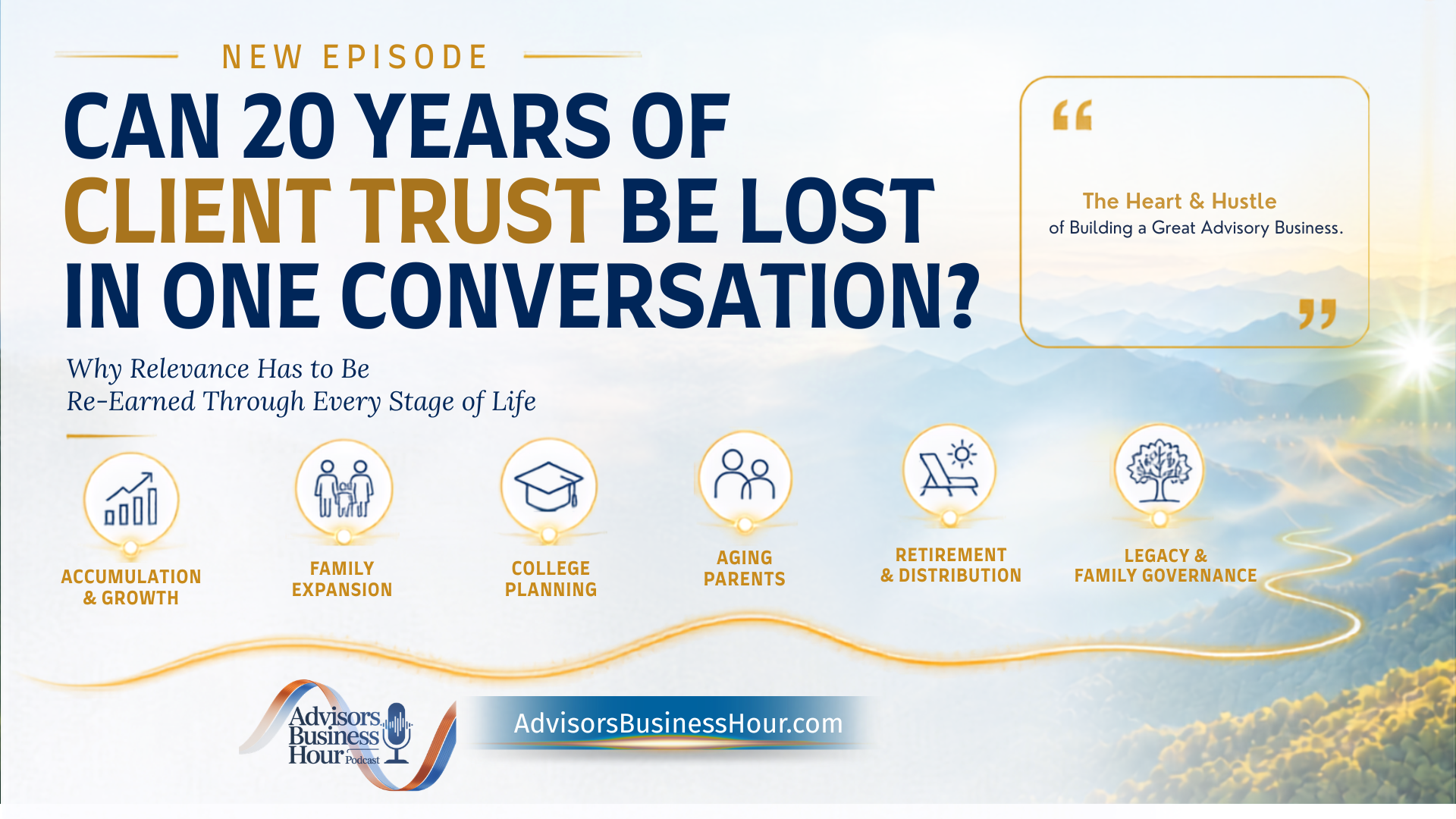
In this episode of The Advisors Business Hour, Jeff Mount and Sherry Sarver-Johnson explore one of the biggest risks advisors face: losing long-term client relationships not because of poor investment performance, but because they fail to adapt when their clients’ lives change.
After years of building trust, advisors can unintentionally lose relevance by responding to retirement, inheritance, aging parents, or major family transitions with the same strategies they used during the accumulation years. Jeff explains why trust must continually be re-earned by recognizing life-stage changes early, asking better questions, and leading conversations before clients start looking elsewhere.
Whether you’re helping clients prepare for retirement, navigate estate planning, or support aging parents, this episode demonstrates why emotional intelligence and proactive communication have become just as valuable as financial expertise.
Why client trust can disappear after years of working together
Many advisors assume that years of successful portfolio management automatically create lifelong loyalty.
The reality is different.
Clients rarely leave because of a single bad meeting. Instead, confidence slowly fades when advisors fail to recognize that a client’s priorities have fundamentally changed.
Major life events often include:
- Retirement
- Divorce
- Birth of a child or grandchild
- Death of a spouse
- Estate planning decisions
- Aging parents requiring care
- Receiving an inheritance
Each event changes what clients need from their advisor. If the conversation doesn’t evolve, the relationship often doesn’t either.
Retirement changes everything
Jeff explains that retirement represents the largest transition most advisors will ever help clients navigate.
Many advisors rely heavily on Monte Carlo analysis and probability models to reassure retirees.
While these tools are valuable, they often answer the wrong question.
Clients aren’t asking:
“What’s my probability of success?”
They’re asking:
- Where will my income come from?
- Can I afford to enjoy retirement?
- What happens if inflation returns?
- What if markets decline early?
- How do I avoid running out of money?
Retirement shifts the conversation from growing wealth to creating reliable income while preserving financial security.
That requires a completely different planning mindset.
Why overconfidence damages trust
One of the biggest mistakes advisors make is responding to client concerns with:
“Nothing really needs to change.”
Although intended to reassure clients, this response often communicates something entirely different:
- You aren’t listening.
- You don’t understand their concerns.
- You’re relying on generic planning.
- You’re not prepared for this stage of life.
Clients experiencing major transitions want leadership—not dismissal.
The advisor who acknowledges uncertainty, explores options, and adapts strategies becomes significantly more valuable.
Every life stage requires a different conversation
Throughout the discussion, Jeff and Sherry explain that financial planning should evolve alongside a client’s life.
Important conversations include:
Retirement
Income planning, withdrawal strategies, inflation, sequence-of-return risk, and portfolio restructuring.
Estate planning
Helping families navigate emotionally charged inheritance discussions while collaborating with estate planning attorneys who communicate effectively.
Family purpose
Understanding what clients ultimately want their wealth to accomplish, such as:
- Funding future generations
- Supporting charitable causes
- Leaving a legacy
- Paying for grandchildren’s education
Aging parents
Preparing clients for:
- Long-term care costs
- Family caregiving responsibilities
- Insurance limitations
- Financial coordination among siblings
College funding
Exploring strategies such as:
- 529 plans
- Gifting strategies
- Generation-skipping trusts
- Multi-generational education planning
Advisors must know the entire family
One of the most surprising statistics discussed is that approximately 92% of advisors lose family assets after the death of the primary client.
Why?
Because many advisors never build relationships with:
- Adult children
- Grandchildren
- Other decision-makers
- Future beneficiaries
By waiting until an estate transition occurs, advisors often meet family members only after trust has already shifted elsewhere.
Proactively involving the next generation strengthens relationships and improves long-term client retention.
Ask difficult questions before clients do
Rather than waiting for clients to raise sensitive topics, Jeff recommends initiating conversations yourself.
Simple questions can make an enormous difference:
- Is retirement starting to feel more real?
- Have you thought about how your spending might change?
- Are your parents beginning to need additional support?
- Have you discussed your estate wishes with your children?
- Is there anything that’s been weighing on your mind financially?
These conversations demonstrate leadership and reassure clients that you’re thinking ahead.
Don’t pretend to have every answer
One of the strongest recommendations from the episode is surprisingly simple:
Don’t try to appear all-knowing.
Instead, tell clients:
“I may not have every answer today, but I’ll bring together the right resources and work with you until we find the best solution.”
Clients value honesty, collaboration, and commitment far more than false certainty.
Why advisors lose relevance over time
Long-term relationships can unintentionally create complacency.
Just as service professionals sometimes become less attentive after years with the same client, advisors can begin assuming they already know what clients need.
That mindset creates blind spots.
Successful advisors continually:
- Stay curious
- Ask new questions
- Reassess goals
- Revisit family priorities
- Adapt recommendations as life evolves
Relevance isn’t permanent—it must be earned repeatedly.
Key takeaways
- Client trust is built over years but can erode when advisors fail to recognize life-stage changes.
- Retirement requires a completely different planning approach than wealth accumulation.
- Statistics and planning software should support conversations, not replace them.
- Estate planning, inheritance, aging parents, and family dynamics deserve proactive discussions.
- Building relationships with adult children helps preserve multi-generational client relationships.
- Asking difficult questions early positions advisors as trusted leaders.
- Advisors don’t need every answer—they need the willingness to find the right solutions.
- Long-term success comes from continually re-earning relevance throughout every stage of a client’s life.
Transcript
[00:00:00] Sherry: Welcome back to the Advisor’s Business Hour, where we dive into the heart and hustle of building your ideal advisory practice. I’m Sherry Sarver-Johnson with Beneficial Business Solutions, and I’m here with my co-host, Jeff Mount, President of Caddis LLC. And he’s also the guy affectionately known as the advisor to advisors.
[00:00:22] Sherry: Welcome to the show,
Jeff. Hi, Sherry. How are you? I’m doing great. Good. ~You know,~ today’s conversation actually started with a question you raised that I haven’t been able to stop thinking about. So here we go. Can 20 years of client trust be lost in one conversation?
[00:00:42] Sherry: In other words, can an ~a-~ advisor do a good job for 15 to 20 years and still lose the client yeah, I think it’s a little more than one conversation. I think most people will, ~will~ give that advisor a real chance to show that they’re, ~they’re~ aware- Uh-huh … [00:00:59] that a life change has, ~has~ just happened.
Why Clients Leave: The Life-Change Trigger
—
[00:01:01] Jeff: My old business partner called it a state change. But, ~uh,~ let’s … A life change. Now, that life change could be, “I just had a child.” ~Uh,~ it could be, “I just got divorced.” It could be, “I’m retiring.” It could be, “I’m looking at death soon and I’m, ~I’m~ thinking about my family and my estate.” If that advisor isn’t able to carry an intelligent conversation right away and be able to make changes to the way they’re doing things for that person, then yeah, they’re gonna be let go.
[00:01:36] Sherry: Okay. So it’s not as dramatic as, “Hey,” you know, they called up, you, ~you~ had a 30-second conversation and whoops, there they go. ~Um,~ it’s more or less the vibe that can come across if you’re not ready for these conversations, where the person just loses confidence because they don’t see that you were able to pivot and handle [00:01:58] that conversation in a way that made them feel confident that you knew how to guide them through this particular life stage or whatever you wanna call it.
[00:02:07] Jeff: The, ~the~
Retirement & the Monte Carlo Problem
—
[00:02:07] Jeff: one that I see the most is, ~is~ retirement. Yeah. And I’ve, ~I’ve~ watched couples, married couples, kind of hint w- what’s, ~what’s~ gonna change when I retire? Mm-hmm. And advisors try to calm them down and say, “Well, nothing.” Mm-hmm. And they’ll use … There’s this thing out there, and the advisors are gonna know exactly what I’m talking about as soon as I mention it, Monte Carlo analysis.
[00:02:38] Sherry: Okay. It was created, ~I wanna say-~ slightly just before the pandemic. Okay. It might be a little farther back than that, but it’s this graph that looks like multicolored spaghetti. Okay. And it, ~it, it, it’s~ ugly as all get out. But what it does is it takes a look at how much you’ve saved for [00:02:57] retirement, and assuming a 60% stock, 40% bond portfolio, the classic balanced portfolio- Mm-hmm
[00:03:05] Jeff: withdrawing 4%, ’cause that’s somewhere, ~somewhere~ somebody determined that that was the safe number, but then you have people yell, “That’s not safe either.” ~S-~ withdrawing 4%, it says, okay, taking a look back over the last 100 years and scrambling the return pattern, how would you have done? And what each of those colored graphs, spaghettis if you will- Uh-huh
[00:03:30] Sherry: represent is that particular graph and how you would’ve done. And then it sums up on average, okay, well, based on what you have, based on the 4% withdrawal, based on Monte Carlo, you have a 76% chance of success. And that advisor might look at them and say, “That’s pretty good.” Mm-hmm.
[00:03:53] Sherry: Retiree probably might say, “I don’t wanna be, ~be~ a victim of your [00:03:56] statistics ’cause this sounds- Right … like garbage.” Right. When you’re on the other side of the table, it’s totally different. ~Yeah. Yeah. Yeah.~ Yeah, so the idea of… Think of it this way. If I, ~if I~ pick a, ~a~ strategy in accumulation phase. Mm-hmm. And let’s call it, ~um,~ a growth strategy, right?
[00:04:13] Jeff: So I, ~I~ don’t care about price to earnings multiples. I’m more interested in can the stocks inside my portfolio consistently beat the earnings estimates? Mm-hmm. ‘Cause that’s, to me as that kind of investor, it’s all I care about. And let’s suppose I make a mistake and stray from that, and I shouldn’t have.
[00:04:33] Jeff: Mm-hmm. And it hurts my performance. Can I recover from it? The answer is yes. Mm-hmm. Generally, the way I recover in it, from that is by putting more money in when it’s cheap. Mm-hmm. When, ~when, when~ things feel awkward, bad, whatever. When I’m in retirement, I don’t have more money to put in there to kind of band- bandage up the mistake.
[00:04:53] Sherry: Right. Right. You [00:04:55] can’t make those mistakes. Yeah. So it really needs to be how do I set up my… How do I, ~first of all,~ pay myself? Which is ~g-~ a weird feeling too. Mm-hmm. And then secondly, how do I get something that’s gonna generate enough income to allow me to pay all my bills and live and enjoy life? And somehow I’ve gotta find a way to get growth because inflation’s always out there.
[00:05:21] Sherry: Right. Right. And we just came, you know, down from a pretty high inflationary environment. We all cross our fingers and hope that doesn’t come back, but there’s always some kind of inflation. Yeah, I mean, it sounds like what you’re saying is a lot of times advisors move into this overconfident from their perspective because they’re looking at, or they might convey the feeling that they’re looking at things from a statistical standpoint versus that particular person’s individual trajectory.
[00:05:50] Jeff: Kind of like a doctor that tells you, “Hey, you know, here’s what you got [00:05:54] and you’ve got, you know, 70% chance of living.” Well, that might not be good enough if- … if you’re the person, you’re like, “Hey, I wanna… Let’s look at some other ideas here. Let’s, ~let’s~ move the needle up.” Um- I think the word overconfident nails it.
[00:06:08] Sherry: You’re right Yeah. So what you’re saying is instead of just downplaying their concerns and trying to soothe over those concerns, you’re actually putting wood on the fire because they’re not hearing the reaction they, ~they~ need, which is they’re, ~they’re~ actually concerned and they want to know what you’re gonna do about it.
Overconfidence and Losing Client Trust
—
[00:06:29] Jeff: They generally start to… Well, they don’t really give th- that advisor who- ~uh,~ too many chances. Mm-hmm. So they’ll, ~they’ll~ typically say, “What are you gonna do differently?” Yeah. And when they hear nothing, major red flags. Mm-hmm. ~Um,~ and they might just then go find somebody else who understands distribution. ~A-~ and there are a lot of different strategies you can go with.
[00:06:52] Jeff: ~Um,~
Distribution Strategies: Buckets of Money
—
[00:06:52] Jeff: probably the [00:06:53] most popular one out there is called buckets of money. I don’t know if you’ve ever heard of that- Mm-hmm … that or not. Yeah, yeah. Uh-huh. So, ~uh,~ to make it ~s-~ it could be three, it could be five buckets, whatever, but the first bucket’s your short-term, let’s just use short-term US Treasury.
[00:07:07] Jeff: Something… It’s kind of a- Mm-hmm … cash alternative. Mm-hmm. Or whatever other cash alternative you like. And the second one might be, you know, a growth and income combination. Uh-huh. And then the last one might be just growth. Yeah, I, ~it’s~ a, it’s a valid strategy. It, will it deliver enough income? I don’t know.
[00:07:25] Sherry: Yeah. Well, I think a lot of our conversations come back to people are individuals. Right And w- what, you know, even in retirement d- people have different risks and, you know, levels that they’re willing to take, and whether they’re more conservative or aggressive or, or, you know, whatever their concerns might be.
[00:07:45] Sherry: And having those people skills, I mean, this kind of goes back to some of the other episodes we did where you spend [00:07:52] more of the time, actually listening than, coming up with solutions. Because then the person knows you’re actively engaged with them to the point that you understand where they’re coming from and you’re not, you know, you’re, ~you’re~ just not trying to slot them in to the, ~the~ next best thing that you’ve got going.
[00:08:13] Jeff: You know, I think you bring up an excellent point. ~Um,~ when you think about, ~uh,~ structured products, ~uh,~ and annuities and options ~a-~ and you think, okay, all three of those kind of use the same kinds of securities inside of them. Mm-hmm. But ~s-~ but, you know, one’s a, ~uh,~ truly an insurance, guaranteed by an insurance company, and it’s for that type of person who really is terrified- Mm-hmm
[00:08:43] Jeff: that they’re gonna run out of money. And then of course you got structured products, which offers a little more flexibility in terms of how much income you’re gonna get [00:08:51] over what period of time, depending upon the product. And of course you got just pure options that have premium income, but that changes on a regular basis.
[00:09:00] Jeff: And, you know, the advantages there, you have the potential for growth and income, ~uh,~ to potentially a significant amount. But again, there’s risk there because things change, and there’s no- Mm-hmm … insurance company backing it. Knowing the social styles of the prospect and the family- Mm-hmm … and, ~and~ the dynamics of the family is going to lead you down a different path in each of those cases.
[00:09:24] Sherry: So great point. Yeah Yeah, I think what you said put, more de- fine detail on what we’re talking about, and getting back to how those relationships can deteriorate very quickly if you’re not proactively paying attention to the questions that are coming through from your client.
[00:09:43] Sherry: ~Uh,~ what are some of the other life stages where you’ve seen people kind of lose a, ~o-~ other than the, ~the~ retirement, [00:09:50] you know, what are some of the other life stages where you, ~you~ see people lose their clients? ~Um,~ be- this is a tough one. ~A-~ and I don’t necessarily blame the advisor for this one, but
Family Dynamics, Estate Planning & Inheritance
—
[00:09:59] Sherry: bringing the family together, the extended family together, whoever’s going to benefit from the will when it’s- Mm-hmm
[00:10:07] Jeff: finally executed because someone passes, ~um,~ brings in a lot of emotions. ~Uh,~ how many families have somebody who has a drug problem- Mm-hmm … or has been divorced multiple times? Right, yeah. ~Uh, you know, h-~ a lot of families have those problems. And, you know, depression and, ~and~ all kinds of things, so- The best thing you could do as the ~un-~ as an advisor, unless you are truly equipped to handle all that, is to find, and this is a hard thing to do, but if you can find a really good estate planning attorney who’s- Mm-hmm
[00:10:41] Jeff: not just a, ~a, a, a~ legal geek, he can- Mm-hmm … actually speak like a human being to these families. Yeah, and part psychologist. [00:10:49] It’s hard. I mean- Yeah … I, ~I,~ it’s, because most estate planning attorneys I know are very smart people. They understand contracts. They understand trusts, but they are not the right people to carry this conversation with a family- Mm-hmm
[00:11:04] Jeff: because they just don’t have the social skills. When you find the ones who do, oh, my God, they’re amazing. And I doubt- Yeah … a CPA could pull this off either. , And I don’t think most financial advisors could pull this off. Yeah. I mean, what you’re describing is literally a minefield,
[00:11:18] Jeff: It can go south- It’s- … really fast. … challenging. I’ve witnessed a few of these, and it’s, ~it’s~ really challenging. Yeah. So that’s one … another place where, ~uh,~ advisors can lose their clients. Yes. Yes. Yeah. I think, ~um,~ the other thing you should be looking at is … And I, ~I, I~ used to teach this in the, ~um, um,~ the training program that I have, Wisdom.
The Family Purpose Conversation
—
[00:11:39] Sherry: We talk about the family purpose. Mm-hmm. ~A-~ and a lot of people kind of roll their eyes at me, and I’m like, “You know, this is … Guys, this is really [00:11:48] important.” What does, ~what do~ the matriarch and patriarch want the most for their family? Yeah. Is it, ~is it~ charitable? Is it philanthropy? Is it, “I wanna make sure that not just my kids but my grandkids and their kids get a good college education without being saddled with debt coming out of it”?
[00:12:07] Sherry: Mm-hmm. There, ~there~ are a lot of different directions we can go with that conversation. ~Um,~ but they’re all very, very important to the people who are making the decisions whether to keep you or, ~or~ kick you to the curb. Yeah. Yeah. So how do you recommend that an advisor both listen for those changing tone of questions and handle the next step, which is stepping up to the plate to help them through this?
[00:12:36] Jeff: Ask the questions proactively. If you can show that you’re aware of these changes happening- Mm-hmm … ~i- a-~ and, ~and~ you want to address it, just [00:12:47] ask. Ask them, say, “I- is this on your mind?” Mm-hmm. Yeah. ~Um,~ would you like to bring everyone … And by the way, most financial advisors don’t even know the names of the kids, who are probably adult children now.
[00:13:02] Jeff: Mm-hmm. ~Um,~ they’ve got to get to know these people, ~um,~ or they’re gonna lose the business. Yeah. You know, I think w- we had a previous, ~uh,~ episode where we talked about this. 92% of advisors, ~um,~ lose the, ~the, the~ family, ~uh,~ once that matriarch or patriarch has passed, and it’s largely because they never bothered to get to know the kids.
[00:13:21] Sherry: That blew my mind a little bit. Yeah. . 92%. That- That’s a lot.
[00:13:26] Sherry: That’s not good. ~Um,~ yeah. So When a family’s going through transition or when your client’s going through transition, what I’m hearing you say is you’ve gotta proactively kind of probe because you don’t wanna necessarily wait until they’re asking you- Right … because at that point they might already be on their way out. They’re asking you because they’ve been looking into it on their [00:13:46] own or they’ve, maybe they know somebody else that they can go to that specializes in this, and they’re giving you a chance.
[00:13:52] Jeff: But if you can preempt that and actually bring it up before it is something that’s been burning on their mind- Yeah … then that’s the way to go because now you’re back a leadership position. It’s, ~it’s~ the same concept when we talked about building websites- Mm-hmm
[00:14:08] Jeff: and we talked about, you know, answering why should I, and then kind of identifying what they might be going through ahead of time. Yeah. It immediately instill, okay, I can trust this person. He, he or she knows me even though we haven’t met, in that particular case. Now, this is someone you do know- Mm-hmm … and it’s even more important because you do know them that you are proactive in saying, “Gee, you know- Yeah
[00:14:31] Sherry: I, I don’t know if you’re ready to talk about this, but if you are, I will be ready to.” Yeah. So a little side note, uh, something that I’ve noticed in other industries, uh, I’ll pick on, hairdressers for example, [00:14:45] the longer that you’re with them the less the less they’re actually paying attention to what they’re doing because we’re talking.
[00:14:51] Sherry: They’re like, like snip, snip, snip. They’re looking off there. You know, when you’re, when you first go it’s like that’s the best you’re ever gonna get because after they get to know you there’s this sense of complacency that enters in and, this is not what we want, right?
[00:15:06] Jeff: We don’t want this to creep in in any type of, , service business or, , especially in this advisory business we need to be on our toes and not let complacency enter in. Like, I’ve had this client for so long, you know, we’re friends, everything’s cool, because this is their life at stake. ~M-~ my daughter’s a hairdresser.
[00:15:26] Sherry: I’m gonna share this episode with her.
[00:15:32] Sherry: We don’t want that in our, ~uh,~ advisory businesses.
[00:15:35] Sherry: We wanna stay very proactive, very conscious, and, ~um,~ focused on, ~on~ being there through the ups and downs with the [00:15:44] clients.
Aging Parents & Long-Term Care
—
[00:15:44] Sherry: Something, I wanted to bring up and, ~and~ get your perspective on is aging parents. , Do you see that as something on people’s minds? Yeah. So aging parents ~i- uh,~ I think, ~um…~
[00:15:56] Jeff: Well, here’s the challenge I have with this one, is- In the advisory, business, it almost always leads to the conversation of long-term care insurance- Mm-hmm … which, ~um,~ is challenging. I mean, it’s… Long-term care insurance, I know started, ~geez,~ back in the ’80s and maybe ’90s with the main company was UNUM. And UNUM’s been through all kinds of financial challenges because the original contracts were too good.
[00:16:28] Jeff: Oh. They were, ~they were, they were~ too rich. Mm-hmm. And, ~and~ the, ~the~ premiums weren’t high enough, and they, ~they~ didn’t promise on paper but they did promise verbally- Mm. Mm-hmm … the premiums wouldn’t go up, and of course they skyrocketed. Mm-hmm. And, ~um,~ [00:16:43] we’ve gone through multiple generations of changes to these contracts, and it becomes kind of frustrating, ~uh,~ as an advisor as to, okay, exactly what are we gonna have?
[00:16:56] Jeff: If I recommend something for my client, what is the likelihood it’ll be the same and effective going forward? And it’s- Yeah … it’s been kind of a crapshoot. And I get it, you know, the insurance companies are struggling because the costs of- Mm-hmm … long-term care, depending upon the state you’re in, I’m in Connecticut, which is one of the most expensive states.
[00:17:18] Jeff: Yeah. ~Uh, i-~ it’s, ~it’s~ crazy how much it is. And, ~um,~ insurance just don’t, ~doesn’t~ cover it all. So it is a tough, tough conversation. There are consultants out there for people who have the money, right? Mm-hmm. And they will literally go out there and find the best place for you. [00:17:42] Mm-hmm. And, ~and~ they’ll shop, like, literally the whole country.
[00:17:45] Jeff: ~Um,~ but it’s, ~it’s…~ They admit, like, “Look, if you don’t have enough money to pay us, we’re not gonna, ~we’re not gonna~ waste our time on this.” Yeah. So it, ~it’s~ tough. Yeah. Well, The whole thing about trying to predict the future is tough, , but we all know that we’re going to get older, or going to be in a situation where we’re gonna need care, if you live that long.
[00:18:10] Sherry: Or your parents, are in that situation now possibly. So it’s, ~it’s~ one of those other conversations that nobody likes to have, but it’s something that has to be talked about, otherwise people are blindsided It, it, listen, ~it~ can cost you everything you have. Yeah. Yeah. ~Um,~ and I do know so many people who go through it, and a lot of times the, ~the~ adult children try to take care of the aging parents, and that’s, ~that’s~ a lot.
[00:18:39] Sherry: ~W-~ yeah. When my husband’s [00:18:41] mother was put in a home, she was- 90, I think, 91, something like that. Mm-hmm. And, ~uh,~ we all spent for three years, ~uh,~ right around 10,000 a month, you know, ’cause she didn’t have, ~uh…~ You know, she had her retirement, but that’s not gonna touch it. No. She, ~she~ didn’t have- Exactly
[00:19:00] Jeff: yeah. And what’s interesting with parents is they don’t always, like, want to tell you what they do and do not have when you have that conversation, and then it’s like, “Well, guess what? We’re all pitching in.” Uh- You know what’s interesting about this is, of course, I’m in the Northeast and a Connecticut Yankee, as they like to say.
[00:19:22] Sherry: ~Um,~ you’re right. It’s taboo for- Mm-hmm … people to talk about what they have, how much, where it is, ~uh,~ what your ~i-~ investment portfolio is like. They, ~they~ just- Mm-hmm … don’t ta- It’s just you can’t do it. Then you go out west- Right … to places like California, and everyone’s very open [00:19:40] about it, and then just they say, “Here’s how much I have.
[00:19:42] Sherry: Here’s what I am invested in.” ~Um, i- i-~ it’s just, ~uh,~ depends on where you are and what the culture’s like, I think, is in terms of who’s willing to talk. Yeah. That’s an interesting perspective. You know, my parents must have been with the buttons up north, although they weren’t from there, they never, ~they never~ talked about money.
[00:19:58] Jeff: That wasn’t something- Which is- Yeah … I get it, but it, ~it’s, uh,~ it’s not a good idea. I mean, you want to make sure that when you finally pass, everybody knows where everything is so it doesn’t just sit stagnant somewhere. Right, right, right. There’s, ~there’s~ a lot of stuff to be, figured out, and the best thing to do is to be proactive.
[00:20:19] Sherry: Well, so, ,
College Funding & Other Life Changes
—
[00:20:20] Sherry: what are some of the other life changes that advisors might miss? ~Um, uh,~ you know, college funding. I, ~I~ did just mention, ~uh,~ sometimes the grandparents want to, fully fund the college education for the grandchildren or their great-grandchildren because they can.
[00:20:37] Jeff: You know, they have time. [00:20:39] Mm-hmm. ~A-~ and generally the kids are very young, so, ~uh,~ there, ~there’s,~ that’s, ~that’s~ an important conversation. There’s a certain degree of, you know, 529 planning you can do, which is college funding through- Mm-hmm … tax-free. It’s called tax-free, but it’s effectively tax-free, , plans.
[00:20:55] Jeff: There’s gifting plans you can do. There’s generation skipping trusts you can use. A lot of different tools to accomplish that. But I think we’ve hit the key ones. The key one really is retirement, ’cause that’s where- The actual makeup of the investment account has to change. It can’t just stay in growth stocks and ~cl-~ close your eyes and cross your fingers and hope that your ~s-~ you know, your 79%- Yeah
[00:21:22] Sherry: prediction’s gonna work in your favor. You just don’t know. Well, you read my mind, ’cause I was gonna ask you which one was the key. I kind of thought it was probably retirement. It’s retirement, yeah. It’s, ~it’s, uh, ~it requires a big, big change. So would you say that that’s also where the [00:21:38] advisor has the greatest opportunity
Retirement: The Biggest Opportunity to Add Value
—
[00:21:40] Sherry: to show real value to their client?
[00:21:42] Jeff: Without a doubt. Again, if you’re proactive, you, ~you~ know. And I’m not suggesting there’s any one strategy that’s better than the others. You have to kind of go through them yourself and understand them. Mm-hmm. ~Um,~ and, ~and~ again, pair it up with the right personalities, the right, ~uh,~ social styles and, ~and~ what’s gonna motivate them versus what’s gonna turn them off.
[00:22:02] Sherry: Yeah, ’cause that’s, ~that’s~ key too because some people might welcome questions and other people might not really want to hear it. So think of this. And I know you because you, ~you~ know me, you know a lot of advisors. How often in accumulation phase does an advisor sit there and go through the financial plan and say, “Here’s the strategy I want” and that person says, “You know what, Sherry, I trust you.
[00:22:27] Sherry: You just do what you want to do.” Do they do that in retirement? No. ~No. No.~ No. When it comes to retirement, they’re like, “Okay, where is the income coming from?” Yeah. “How do [00:22:37] I get it?” Yeah. “How is this all gonna work?” It’s a completely different- Right, the time is not- … uh, approach When you’re younger, time is on your side.
[00:22:46] Jeff: It, ~you know,~ you can make up for those gaps, everything. I mean, there’s a great, ~there’s a great~ commercial. I don’t know if you’ve seen the, ~the~ JP Morgan commercial where they talk to the couple who’s now in retirement, and they said, “We’re scared. We don’t know how to do this. This is really scary.”
[00:23:00] Jeff: It, ~it’s~ a legitimate response. ~Uh-huh.~ Um, you see it, in real life you see that a lot. I can imagine. Yes. ~Uh,~ you know, the other thing is I think having the skill to bring up sensitive subjects is something that we can all work on. And do you have any tips on how to do that
[00:23:22] Jeff: I know you talked about knowing their personality profile and so forth, ’cause that, ~that~ would help a lot in knowing what to say so that you don’t push them away, ~uh,~ you actually open up a conversation that’s needed and that they [00:23:36] welcome. What are some tips that you could leave us with that, on that?
Tips for Having Sensitive Conversations
—
[00:23:40] Sherry: Don’t pretend to know all the answers. Ask the questions. Let them know upfront, “I, ~I~ don’t know if I’m gonna be able to satisfy your curiosity- Mm-hmm. Mm-hmm … but I’ll do everything I can. I’ll bring in the resources I have to help uncover what could be a great solution.” Don’t pretend to know everything, ’cause nobody does.
[00:24:01] Sherry: Yeah. But let them know that you’re gonna go to work for them. Right. Exactly. I like it. All right, well,
Wrap-Up & Where to Find Jeff
—
[00:24:09] Sherry: anything else you want to leave us with before we wrap it up today? I feel like this conversation has been very enlightening- You know, it’s- … as always … we have talked about creating your niche and- Mm-hmm
[00:24:22] Jeff: staying with it. ~Um,~ I think a lot of people when they hear that think, “Well, gee, that’s gonna be mechanical and, ~and~ easy- Mm-hmm … because everyone’s gonna be the same.” Well, I think we just proved today that’s not the case. You’re [00:24:35] still gonna be earning your fees. Yes, yeah. ~Uh,~ there’s a lot you have to apply.
[00:24:39] Sherry: Yeah, the niche is great for marketing, it’s great for, ~for~ bringing in some commonality among your clients, but everyone’s unique, everyone’s different, and everyone’s going through different stages of life, so- Yeah … gonna keep you on your toes. Yeah. It’s interesting, you know, we’re, ~we’re~ all the same in many ways, like we all go through the similar emotions, but we, ~we~ approach things differently.
[00:25:01] Sherry: So that’s, ~that’s~ where the, ~the~ uniqueness comes in. I mean, even in the same family you can’t get the ~s-~ the same approach or the same outlook on what should be done. So, ~um,~ that’s all very, very good stuff. So what I’m taking away from today’s conversation is the client relationship is always evolving, and the advisor that’s, wanting to be successful with their clients for the long term needs to evolve with it.
[00:25:28] Sherry: The advisors who recognize those moments and step into the conversation early [00:25:34] can become very valuable to their client in their new chapter. Certainly more trusted, yes. Absolutely. Listen, if you’re afraid of being replaced by an AI bot, today should teach you, no you won’t. Yeah. Yeah. And ~th- and~ these are people skills, it keeps coming back to.
[00:25:45] Jeff: That’s, ~it is. ~Absolutely. That’s right. Jeff, where can our listeners find you, and how can they learn more about what you do and how you help them become more successful? I would suggest reaching out to me by email, Jeffrey, J-E-F-F-R-E-Y, @caddis, C-A-D-D-I-S, .biz, B-I-Z. ~Uh,~ best way to start is there. Um- Lots of different topics we could cover, from digital marketing to SEO to, ~uh,~ coaching and training programs, to the sales map itself, just to kind of ~u-~ uncover your strengths and weaknesses.
[00:26:22] Sherry: Well, you’ve been doing this a long time, and I know you’ve got a lot of programs that you’ve carved out over the years to help advisors up their game and, , stand out in the [00:26:33] marketplace be able to communicate to potential clients and current clients the value that we bring to the table.
[00:26:40] Sherry: Thank you, Sherry. Thank you, Jeff. As always, super fun. And thank you for joining me today. Look forward to seeing you next time. And to all of our listeners, thanks so much for being part of our community. If you have questions or suggestions, please send them our way. Thanks, Sherry. See you soon. All right.
[00:26:59] Jeff: Take care, Jeff. Bye-bye. Bye.