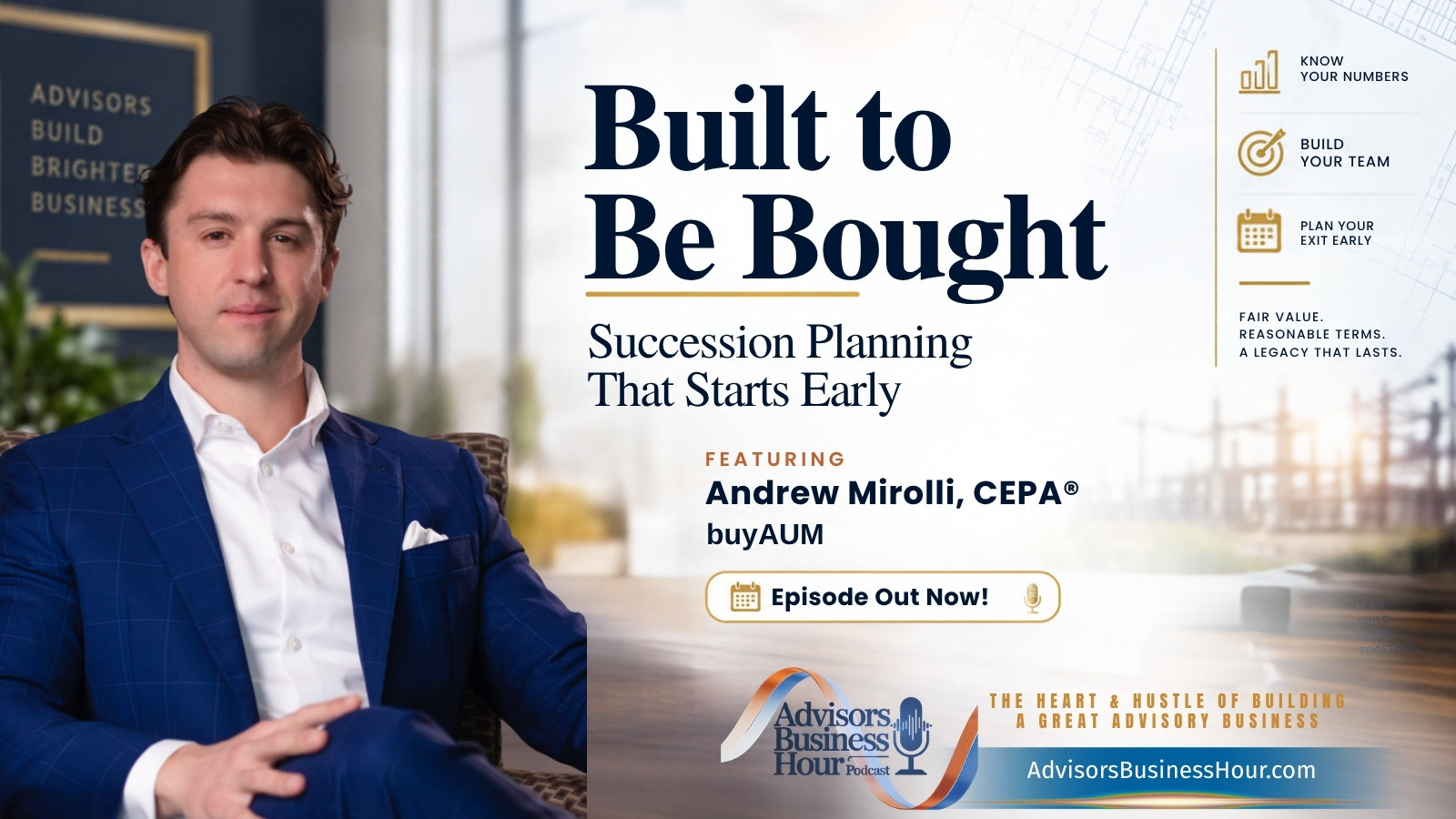
Andrew Mirolli’s work at buyAUM grew in part from watching his father, an advisor for 25 years, struggle through a partnership transition. What should have been a planned next chapter became a complicated process that ultimately led to the partnership splitting apart.
That experience highlighted a major gap in the advisory marketplace: transitioning a practice is not simply a matter of listing a business and accepting the highest offer. Advisory firms are built on personal relationships, trust, and years of service to clients.
Andrew and his co-founder developed a more consultative process focused on understanding the seller’s goals and finding a buyer who fits the practice—not just the numbers.
Price Is Only Half the Deal
One of Andrew’s most important distinctions is the difference between price and terms.
A seller may have a reasonable expectation for the total value of a firm but insist on receiving too much of the purchase price upfront. That can place an unreasonable amount of risk on the buyer and make an otherwise viable transaction difficult to complete.
Andrew explains why sellers should consider how a deal is structured, including potential payments at closing and additional payments over the following years. A balanced structure can help align the interests of both parties and make a transaction more workable.
The lesson: the best deal is not necessarily the one with the biggest headline number. It’s the one with a fair price, reasonable terms, and a realistic path to a successful transition.
Know Your Numbers: Revenue vs. EBITDA
Understanding a firm’s value starts with understanding how it makes money.
Andrew explains why advisors should consider both revenue-based and EBITDA-based valuations. Revenue provides a view of the firm’s top line, while EBITDA helps reveal the earnings remaining after operating expenses, before interest, taxes, depreciation, and amortization.
The right valuation approach can depend on how a firm is structured. A practice with significant infrastructure and a strong team may have a different financial profile from a solo advisor with minimal overhead.
Knowing both numbers helps owners understand how a buyer might assess the business, identify potential concerns, and make more informed decisions before entering the market.
Your Client Relationships Are Part of Your Valuation
An advisory practice may look attractive on paper, but buyers also need to consider whether client relationships will continue after the founder leaves.
Andrew points out that advisors often serve clients who are similar to themselves in age. If a retiring advisor has an older client base and has not built relationships with those clients’ adult children, the buyer may see a greater risk of future asset attrition.
His recommendation is to start building a bridge to the next generation well before retirement. Introducing younger family members, developing relationships across generations, and making the firm relevant to the entire family can help support continuity.
Succession is not only about transferring accounts. It’s about transferring trust.
Build a Business That Doesn’t Depend on You
Andrew challenges advisors to consider what would happen if they could not work in their business for 90 days.
Would client service stop? Would new business dry up? Would employees know what to do? Would essential information be inaccessible?
The answers reveal how much of the firm depends on the founder personally.
Building a more transferable business means documenting processes, establishing standard operating procedures, delegating responsibilities, and creating systems that allow the firm to operate consistently without the owner managing every detail.
It also means bringing other team members into client relationships so clients recognize and trust the people who will continue serving them.
Develop the Next Generation of Your Team
A succession plan becomes more practical when clients already know other people in the firm.
Andrew discusses the value of introducing a younger advisor or another trusted team member into client meetings before a transaction takes place. Long-standing employees can also play an important role in maintaining continuity, particularly when they have already earned clients’ trust.
This takes time and investment, but it reduces the risk that clients will feel they are losing their advisor overnight.
A buyer is not simply acquiring a book of business. They’re acquiring the probability that the revenue and relationships will continue.
From a Lifestyle Practice to a Transferable Business
Andrew distinguishes between a practice that generates income primarily for its owner’s lifestyle and a business that can operate independently of that owner.
A solo practice with undocumented processes and responsibilities concentrated in one person’s head may still find a buyer, but it may not command the same value as a business with established systems, a capable team, and repeatable operations.
The goal isn’t to diminish what a solo advisor has built. It’s to understand that a firm becomes more transferable when its value exists beyond the founder’s personal effort.
Done early enough, succession planning can help create a stronger business that is more sustainable, less stressful to run, and more attractive to a future buyer.
Key Takeaways
1. Start succession planning early. The best time to prepare for a transition is often years before retirement, when there is still time to strengthen the business and client relationships.
2. Understand both price and terms. A strong headline valuation doesn’t guarantee a successful deal. Payment timing, risk allocation, and deal structure matter.
3. Know your revenue and EBITDA. Understanding both measures helps advisors evaluate their business more accurately and prepare for buyer conversations.
4. Build relationships with the next generation. Connecting with clients’ children and families can help protect continuity and reduce the risk of assets leaving after a transition.
5. Create systems that work without you. Documented processes, clear responsibilities, and repeatable operations make an advisory practice more transferable.
6. Bring other team members into client relationships. Clients should already know and trust the people who will continue serving them after the founder exits.
7. Understand what buyers are really purchasing. Buyers are evaluating not only current revenue and earnings, but also the likelihood that those results will continue.
8. Build a great business, not just a business to sell. Effective succession planning can improve operations, create more flexibility, and make the firm more sustainable—even if the owner decides not to sell immediately.
9. Look beyond the highest offer. Cultural alignment, investment philosophy, geography, client fit, and legacy can be just as important as the purchase price.
10. Make the business less dependent on its founder. The more the firm relies on one person’s knowledge, relationships, and daily involvement, the harder it may be to transfer successfully.
About Andrew Mirolli and buyAUM
Andrew Mirolli, CEPA®, is Co-Founder and Managing Partner of buyAUM, a company that helps financial advisors navigate practice acquisitions, business valuations, and succession planning.
His work focuses on helping advisors understand what their firms are worth, explore transition options, and find buyers who align with their goals for their businesses, clients, and legacy.
Andrew’s interest in this work was influenced by his father’s experience transitioning from an advisory practice, which helped shape buyAUM’s consultative approach to connecting sellers and buyers.
Connect with Andrew:
Website: buyAUM
LinkedIn: Andrew Mirolli
Valuation resource: Andrew’s resources for advisors
Transcript
[00:00:00] Welcome back to the Advisor’s Business Hour, where we dive into the heart and hustle of building a great advisory business.
I’m Sherry Sarver Johnson with Beneficial Business Solutions, and I’m here with my co-host, Jeff Mount, president of Caddis LLC, and the guy we affectionately call the advisor to advisors. Welcome to the show, Jeff. So good to see you, Sherry. It’s great to see you.
And Jeff, I understand we have a very special guest with us today, Andrew Mirolli.
Andrew is the co-founder and managing partner of BUYAUM, a company that helps financial advisors navigate practice acquisitions, business valuations, and succession planning. Andrew works with advisors who are looking to grow their businesses through acquisition, as well as those preparing for the next chapter of their careers.
His work focuses on helping advisors [00:01:00] understand the value of what they’ve built, explore their options, and find the right fit when it’s time to make a transition. And Andrew brings a personal perspective as well. His own father’s experience transitioning to an advisory practice helped inspire the creation of BUYAUM.
Andrew, welcome to the Advisor’s Business Hour. Sherry and Jeff, it’s a pleasure to be here. Um, I’m excited to this conversation. I love the work that we do, and we are kind of like Jeff, the advisor to advisors. We help folks that have been stewarding relationships for 30 or 40 years and they go, “Now what do I do?
Uh, I don’t know the options that are available to me. How do I do that? What’s the value of my business?” And so we come alongside of them in a completely free way. We’re totally compensated by buyers if the transaction occurs. So it allows us to be super consultative and ask folks like Jeff or an advisor, say, “What are you really looking for?
What’s a good [00:02:00] fit for you, for your clients, for your family?” Um, so I- I’m really excited for the- the conversation we’re about to have. Thank you for having me, Jeff and Sherry. Well, we’re excited to have you too as well, Andrew. Uh, it’s interesting because we had a recent conversation with an advisor who specializes in helping businesses, uh, such as the trade, such as plumbing and so forth- Mm
sell at the end of, uh, you know, when they want to retire, to be able to build that legacy and sell. So I think it’s interesting that now we’re kind of turning the spotlight onto what that journey could look like for an advisor, and it’s really great to have you on. I mean, one of the things that when I first saw your profile was like, I am so curious how you got into this business, how you decided to start it.
I know there was a little bit of background with your father. Uh, could you spend a couple minutes just enlightening us on that? Yeah, I’d love to. So the, the easiest way to sum it up is, is any great business start is find a need and [00:03:00] fill it, right? Mm-hmm. And so I’d been an entrepreneur for many years. My background was in private equity, private placements, oil and gas, venture capital, calling advisors saying, “Let me tell you about this great investment and why it’s a fit for your high net worth individuals,” right?
Um, I then, the, the best part of this story is I got a cold call, it was like a We- a random Wednesday years ago, who’s my now business partner and co-founder. And he said, “Andrew, I want to be honest with you, it’s a cold call. Do you want to hang up or let me have 30 seconds?” And I was like, “Man, I make cold calls all day.
That is a great line. What do you have,” right? That is a great opening. And, uh, so we s- we spoke for, like, an hour. We ended up meeting, like, once a month on Zoom. I live in Atlanta, he lives in LA, greater areas. Um, and we kind of just became friends talking about business and, uh, eventually we said, “What if we started something together?”
And the, I, I had watched my father, who was an advisor for 25 years. He was one of five partners. So he was in a, a group [00:04:00] of five. They had about 5 to 600 million in assets. Great firm. He was the old guy, old relative, like he was 61, 62. I, I give him grief, right? He’s my dad, I could do that. Um, he was the older advisor and the biggest producer.
So he looks at his partners and he goes, “All right, either buy me out or we got to find someone to, you know, take over the business to buy me out ’cause I’m not going to be here forever.” He had worked two jobs for a long time. He’s like, “You know, I want to spend time with my wife and family.” 18 months later, the partnership has been split apart.
There’s only three advisors left. They finally join a firm, and there’s obviously a lot of gray hair in the middle of that. What I saw was that the way that it’s being done, this transition, is like Zillow for advisory businesses. Mm. And yet, the advisory business is so personal. These are my clients, they’re my friends.
Like, I’ve been with them for 30 years, and yet I’m just putting a [00:05:00] listing out and seeing who offers me the biggest check. Like, what a miss. And so we, we said, “Okay, how do we flip that upside down and do it completely different?” Let’s almost take a slow consultative approach. My father’s name is Dave. Dave, okay, first of all, what’s the value of your practice?
Okay, right. Is it 100 times revenue? Which everybody kind of has the country club multiple. Oh, it’s worth… Jonathan got 12 times revenue, I should get 12 times. It’s like, well, you know, where’s the ballpark that you’re in? What matters to you besides money? Culture, investment philosophy, geography of the new advisory.
Like, other than the money conversation, let’s have a whole hour where we discuss what’s important other than that. And then let’s talk about what’s a deal structure that you would say yes to. So our process is, like, four and a half hours with the seller to really understand what are you looking for, right?
Mm-hmm. Then our team goes out. We’ve got probably 15, maybe 18 different buyers that we’ve sourced, vetted. [00:06:00] Like, they’re legit buyers of, of a different ilk, right? Some are, you, you can only be fee-only. Some are like, “Great, we love Series 7.” Some… It’s like everybody’s got a little d- different flavor. Based on the four and a half hours that we’ve just spent with a seller, great, we’ll match you to two but no more than three buyers, right?
And we’ll help kind of shepherd that the whole way. Completely different than, “Jeff, what’s your revenue numbers? What’s your average account size? Great, let me blast it to 2,000 people- Mm-hmm … and let’s start a bidding war, and good luck with everything.” Right? So that’s kind of the, the, the find a need and fill it.
We saw the way that it was currently being done. Very impersonal, very marketplace, very numbers driven. How do we take it down and focus on the individual, the person, and ultimately the clients that are behind the advisor? Let me ask a question, Andrew. Um, I, I, I’m sure the single biggest challenge when talking to the seller is finding [00:07:00] a number, a multiple that’s realistic.
A- and everybody has their own i- inflated view of what the thing is worth. What is the single biggest challenge that you face in this conversation that just leaves you with your jaw on the ground, “I can’t believe they’re saying this to me right now”? I think it’s less… It’s a good question, Jeff. I think it’s less about the ultimate multiple, and sometimes it’s, it’s structure.
Like, there’s price and there’s terms, right? They’re two separate things. Like, so I could say, like, we’ve got a seller that we’re working with w- right now. He wants $2.4 million for his practice. Not crazy. Little high, but, like, it’s within the ballpark, right? I think he’s doing 800,000 a year in revenue.
Mm-hmm. He’s like, “I want $2.1 million at closing.” I’m like Buddy, like, look, you’re not out of the ballpark for total enterprise value of your business, right? Three and a [00:08:00] half, four times, depending on what… Is it EBITDA or revenue, right? You’re in the ballpark. But the amount of risk that you’re asking the buyer to take and giving you almost 80% of that upfront.
And so he… And so it’s this balance of like we go through our process and it’s like, what else matters besides the money? You know, these things, but it always kind of keeps coming back to the money. And this is n- one out of 10 advisors. Most advisors, the top one or two are fit for my clients, continuation of my legacy, culture, geography, that kind of stuff.
Money’s usually four or five on the list of the top five because fair market value is fair market value. It is what it is, right? You’re not gonna have this dramatic difference of these guys offered me 45% more than the… It’s probably 10 or 20% difference, right? We just… I just got two LOIs yesterday. One was for 500K.
It was a small practice. 500K total enterprise value. The other one’s 625. [00:09:00] So, like, materially difference, but not double, right? The issue comes down to I want it all up front, and you’re asking a buyer to take on so much risk that it, it just becomes unfeasible. And so it’s where– it’s less about the price that kind of is the jaw-dropper.
It’s often the terms, and they all have reasons for it, right? I wanna build a house in Boulder, you know, whatever it is, right? And they have good reasons. It’s the inability to put yourself in the buyer’s shoes and kinda understand the seesaw of risk. Someone might give you a lot of money up front, but there’s gonna be a big old hook in it and collateral and attrition and all of this stuff.
The best deals that happen are advisors that say, “I really want fair value for my practice. I’ve got a great practice, and I’m also reasonable on terms.” Right? Let’s do a third, a third, a third or 50% upfront, 25% after year one, 25% after year two. Everybody loves those kinds of [00:10:00] structures, and it allows your multiple to be…
L- look, we’re, we’re playing in the lower market, right? Lower middle market, so usually less than sub-800 million in AUM. Okay. We’ve done deals this year that are 30 million. We’ve done ones that are 600 million. So, like, that’s the world we play in mainly because there’s usually one or two decision-makers.
I don’t love the committee approach. You’re trying to solve for 16 different people’s needs. It’s messy. It takes too long. We can get it done, but I prefer a one or two business owner kind of decision-maker. But it’s less about I want this crazy headline multiple number because we’ll tell them straight up, “You got a three-bedroom, two-bath house.
Yes, you could finish the basement and it could be a five b- but it’s not.” Right. You have a three bedroom, two b- bed… Like, it’s 2,000 square feet. That’s what it trades for. And so sometimes folks come in and they go, “Oh, but you could put an addition on the house, and there’s all this extra land.” It’s like, yeah, but you haven’t done that.
And so the price [00:11:00] that you’re gonna get is for the business as it exists today. That is usually easier to transit- to translate and perhaps someone to kind of latch onto. It’s the terms that sometime make me go Jeff, you can die on that hill if you want to. I’m not gonna die next to you, though. Okay. Like that, you know, and that’s how we have to leave it sometimes.
And y- y- let’s clarify when we talk about, uh, multiples, and you mentioned it a minute ago, revenue versus EBITDA. Um, I’ve, I, I know the industry, everyone in the industry talks about multiple revenue. Do you ever really use multiple revenue as the primary, uh- Sometimes you- … uh, valuation? Yeah. I mean, the smaller the practice, I think it’s easier to use top-line revenue.
Okay. Right? Hey, you’re doing 600K a year in top line, we’ll pay you $1.8 million for the business. I mean, it’s a win-win. There’s not a huge amount of risk. I’m not taking out a loan of $7 million and paying carrying costs on [00:12:00] that, et cetera. Um, so I think it’s beneficial if, for a business owner that’s listening to this, it’s beneficial to know both.
Because if, I always talk about the lemonade stand. If you have a lemonade stand that’s generating $100 in revenue, and I’m gonna buy it for, let’s say, for round numbers sake, four times revenue. So the value of the, of the lemonade stand is $400. But I’ll say I’ll buy it for, you know, six times EBITDA. Okay, well, two lemonade stands.
Okay, this lemonade stand uses paper cups and lemons from Costco, and this one uses crystal, and they’re all super organic farm-to-table lemons. The costs are gonna be dramatically different. So yes, I’m gener- both stands are generating $100 in revenue, but the profit is very different. And so if I value both based on reve- revenue, they’re both worth $400.
If I value them based on EBITDA, there could be a significant delta in that. [00:13:00] And so for firms that say, “Look, we’ve got a great team. We’ve got a lot of infrastructure. We have 35 to 50% margins,” you’re probably better off trying to finagle your way into a revenue multiple, right? Sure. If you say, “Hey, like I’m a solopreneur, I’ve got one assistant, maybe not even that, I work out of my house.
I’m doing 800, a million a year in revenue and I’ve got 50 grand worth of expenses,” well, you should probably finagle your way into an EBITDA multiple, ’cause the EBITDA numbers are always gonna be higher, right? If it’s three times revenue, it’s gonna be four, four and a half times EBITDA. And so it behooves the advisor and the business owner to know w- what’s beneficial to them.
Because if I get in the conversation, I go, “Look, I want, you know, X for my business.” And you do the numbers and you go, “Jesus Louise, that’s four and a half times revenue for the size of practice. That’s crazy.” And you go, “Yeah.” But how about four and a half times EBITDA? You go, “Oh, well [00:14:00] that’s very reasonable, actually.
Okay, well, 95% of my revenue’s EBITDA.” And so it’s just this deeper conversation of how is your business structured. It’s not bad or worse. There will be a buyer for different ones. Some buyers we work with only do EBIT evaluations, some only do revenue. But I think it behooves the business owner to know their numbers.
It’s all of the… I love, um, audiobooks, and I listen to a lot of old autobiographies of the greats, the Carnegies, and, and they always say, “Gentlemen, watch your costs.” Like, you can’t, you can’t control a lot of things. You can control your costs. And so knowing your numbers and the difference of if I’m applying a revenue multiple to my business versus an EBITDA, here’s the delta in my enterprise value, is a very valuable exercise to run.
Nice. I, I like the idea of doing both, without a question. Uh, because you’re right. One, a seller could promote whatever makes them look the best, and- And we do both, right? Yeah. Uh, on our website, it’s a totally free, we call it the true value report. [00:15:00] We’ll do a revenue. We do recaps of EBITDA ki- to kinda normalize that.
I like to see your revenue multiple and your EBITDA multiple have a very small delta. Right. That tells me it’s a healthy business. If one’s dramatically higher or lower, either most often you have a lot of costs. And so a buyer might say, “It’s a great business, but I’m gonna have to incur seven employees and a class A office space, and blah, blah, blah, blah, blah.”
So it’s, it’s valuable to do if you just wanna do a true value report on our website. It takes, like, five minutes to fill it out. Our team does it. I run our finance department. You know, maybe it’s a guess ahead of time. Okay, well, how… what’s the delta between my revenue multiple number and my EBITDA number, um, that it’s something good to know Um, you and I both know that most advisors have clients that kind of look and feel like them.
Same age. And if I’m a buyer, I’m probably younger, and I’m buying an older advisor’s [00:16:00] book of business, and hopefully they understand that you’re, you’re kind of renting it, right? ‘Cause people are gonna die, and you’re, you’re building relationships, hopefully with them and the family, potentially the next generation, and, and, and that’s what you’re buying.
Question is, in your calculation, do you factor that in as potentially affecting the valuation, the fact that that book that you’re buying is an older book of business potentially? It has to be thought about. It’s a very real demerit on a valuation, right? If I want best in class value, there’s this optimal time to sell your business.
Newsflash, it’s earlier than you think it is, right? It’s when you’re not ready to retire. When you’re re- when you’re 68, 73, and you’re like, “Okay, I’m finally done,” you’re right. It’s like the, the owners of the dogs start to look like the [00:17:00] dogs. Like, your clients begin to look like you. I’m 73, you’re it. And so either, there’s two ways to combat that.
One, five to 10 years before you are ready to retire or if you’re in your 50s listening to this, do this one thing. Build a bridge to the next generation. Mr. And Mrs. Smith, you’re my biggest client or you’re my medium sized client or it’s all clients, I say, “I’m not charging fees on your children.” $20,000 account, $50,000 account.
Like, it’s better to have a lower average account size, but it’s the children of your large accounts. Then go, “Oh, my average account’s $2 million, but I don’t have any of the children,” right? Mm-hmm. So that’s something that takes time to set up A lot of people miss it. One thing you can do to increase the value of your practice whenever you wanna sell it is have the children of your relationships.
So that’s really the only way to combat a buyer looking at your [00:18:00] numbers and going, “Okay, 73, 78, 69.” And it’s like this is a diminishing asset. They’re on RMDs, they’re past life expectancy. But you go, “Well, yes, but look right below it, 25 years old, 40 years old. I have the next generation.” It’s hugely important.
Yeah. So, I, I- Wow, Andrew, I really… Sorry, Jeff, just wanted to say. No, go ahead. I really like the way that you’re bringing out a lot of the stuff that we actually talk about on this show, and, uh, this is another topic that Jeff hammers. Uh, the book of business needs to include the family. It needs to include the next generation, and you’re just showing how important that is when it comes to the business evaluation of things.
Jeff, go ahead, and what were, what were you gonna ask? No, it’s, I’m kind of building on what you’re talking about. You know, we talk about grow– the three stages of the advisor’s life cycle, grow, maintain, and exit. And, and what I love about this conversation is when I talk about exit, I talk about the [00:19:00] things you should be doing to prepare for an exit.
I do not get involved with actual valuations and matching buyers and sellers, so it’s, it’s great that we have you. Tell me what… ‘Cause you can’t just prepare your business for exit and then 30 days later sell it, not, not very effectively anyway. If you’re tooking– looking at two to five years before you’re ready to actually exit, tell me what are some of the conversations that should be had, what are some of the– what’s some of the planning that should be done to make sure that it’s an effective and easy transition to the buyer?
If you wanna do the work, here’s what you should do. If you don’t wanna do the work, understand you’re not gonna get best in class value. And some people are totally fine with that, right? So I wanna caveat it. Like, there are buyers for your practice if it’s a solo run business, it’s all on an Excel spreadsheet, and there’s no systems that live outside of your head.
It’s not gonna be as valuable as it could be, but, [00:20:00] like, there’s a lot of work to do what I’m about to say. So, like, if that’s you, that’s okay, just understand you’re not gonna get this best in class multiple. If you ha- And what I love about succession planning is if you do it early enough, it looks like building an awesome business, Jeff.
It’s taking yourself out of the center node of all aspects. If every new client is only someone you can service, only someone that answers your phone call, only someone that respects your opinion- How the heck am I supposed to replace you, right? Even if it’s over a year. And so beginning to have a team.
Okay, well, I wanna keep my margins high. Okay. Well, is there a, a, an assistant or a salesperson that can be on your team that can also be in the client meetings that maybe is a younger face? We’re doing a deal with a gentleman in Houston. He’s 62, 63. His, like, longtime right-hand woman is in her early 50s.
She’s not going anywhere. [00:21:00] A buyer says, “Great,” right? I can bring in a new advisor but, we’ll call her Cheryl, Cheryl’s gonna stay there. She’s not changing. People know Cheryl. They love her. She has earned their trust over time. So that’s one aspect is bring an- uh, another person into the business and conversation.
Yes, it takes money. It takes work. Again, you don’t have to do it. It’s a good idea. The second is take things out of your head. We always run this example of, “Jeff, if I locked you in a room for 90 days, you have food and water, you can’t touch your business for 90 days, what breaks?” And it’s an exercise that people just, they move so fast through life, and I’m building my business, I’m like…
But if you pause and you have a cup of coffee or you’re on a walk and you go, “What would break if I was not able to access my business for 90 days?” That will give you the laundry list of things that need to be taken outside of your brain and systemized, whether it’s through automation or a standard operating [00:22:00] procedure that like, hey, we’ve got a, a laminated thing.
When a new client comes in, these are the steps that happen and how often. When a client calls for service, this is what happens. And so it’s, the, the less that it’s all dependent on you, the better. I used to work in private equity, and all of these guys say, “I’m looking for businesses that are a minimum of 5 million in EBITDA and up.
Doesn’t matter the industry, 5 million EBITDA.” And I asked them, I said, “Why is that?” Right? Like, there’s plenty of great businesses, and you can get it for, for cheaper, that are 2 million in EBITDA. And they said, uh, it’s like an arbitrary number, but over that line, there’s systems. Mm-hmm. It’s not all dependent on the owner.
And so it’s not exactly the same here because that’s a tremendously large advisory business at 5 mil. But I think it highlights a buyer’s perspective. If I’m just buying this lifestyle practice, there’s so much more [00:23:00] risk attached to it. And so it’s about understanding where are the risks. Someone’s not just buying your revenue or EBITDA.
Yeah. They are buying the probability that that revenue and EBITDA continues. Yeah. Well said. So… Yeah. So what, what you’re saying, Andrew, is the operational side that runs underneath everything that people can see, and they, and the valuations that you, you’re talking about top line valuations and EBITDA, uh, but without the operational side being in order, those valuations kind of fall apart because how is a new person gonna step into the shoes of the advisor and run something that’s really all revolving around that advisor that’s leaving the practice?
Absolutely. Yeah, you used a, um, a, a, a description a minute ago, a lifestyle business. Yes. I- And, and, and it’s, let, let’s, let’s make sure everybody who’s listening understands what that means. [00:24:00] What that means is whatever revenue I’m generating, I’m spending, and it’s, it’s supporting my lifestyle. That is not the business model we really support here.
Uh, it- Yeah. If it’s, it’s a high paying flexible job. Yes. Right? Like, it… Let’s call it what it is. It’s not a… And I don’t wanna be- like, poo-poo someone’s business, but like- It’s a, it’s a high paying job that you’ve built for yourself that’s hugely flexible. Congrats. It’s different than system business that can run without you.
Exactly. Yeah. So the, the, the, the formula that I often use, and some people will dispute and say, “No, I don’t think that’s right,” but it, 40% of revenue should be committed to overhead, 40% is for your income, and 20% is for marketing and sales. So to your point, if I’m locked in that room with bread and water for 90 days, if s- if the machine is running for marketing and sales, and I already have systems in place to [00:25:00] handle the actual portfolio management, I’m not doing it myself, that is something that’s truly valuable and easily transferable to a buyer, and they’re willing to pay a lot more of a multiple for that.
So versus- Or just- … a lifestyle business. Or you just keep it running because it’s not driving you into the ground. That’s right. Mm-hmm, mm-hmm. You’re at 60 wanting to go, “I could do this for another 10 years.” Yes. Yeah. “I can be, I can be in France for a month, and it keeps running.” So I’m not even thinking.
No. And so it’s like, yeah, I have another 10 years of revenues. No purchase price is gonna come close to 10 times revenue. So, like, again, it goes back to good succession planning done early and executed well is building an awesome business. That’s what people miss. Yeah. Well, Andrew, I love how you’ve brought all this together and given us the background of how you got started.
The comparison of the way the in- most of the industry is run, which is, is like Zillow and is very [00:26:00] transactional to comparing to what you and your partner do at BUYAUM is so refreshing because we talk about this too, everything is relationships at the end of the day, and if you don’t understand the client and you don’t understand also the way you brought out, too, the buyer, uh, the seller is not gonna be successful if they don’t understand how the buyer’s perspective, uh, how the potential buyer is going to be looking at the situation, and just how you bring all the parts together and actually educate your client on how they can put themselves in a better position, how they can maybe tweak their systems.
It’s just really neat to see how you bring all that together, and we really appreciate you being on the show. Jeff, do you have any questions for Andrew before we wrap it up? I, I don’t think so, Andrew. Any more? I think you did a great job. I know there’s gonna be a lot of people who follow up and wanna pick your brain on this, this topic.
It’s certainly the hottest topic in the [00:27:00] RIA space. So, uh, uh, uh, we will do everything we can to steer those, those questions and comments and concerns to you, and, uh, really appreciate your, your input today. Absolutely. Oh, it’s, it’s been a pleasure. Yes, it’s been really great, and it’s so informative, too, to anybody who is either starting a practice or in the middle of practice because this, like you said, needs to be thought about early on, the earlier the better.
And really everything you laid out is actually how to build a great practice. Yeah. So thanks so much. Please tell our listeners how they can find you, Andrew. Yes. Um, so they can find… I’m all over LinkedIn, Andrew Mirolli. Uh, our website’s BUYAUM. Top right of our website is a button for the free true value report, five minutes, self-entered data.
We usually get that out in 24 to 48 hours from our team. Uh, that’s a great place to start, right? There’s no strings attached. Like I said, we’re completely comped by [00:28:00] buyers if and when deals close. We’ll never send you an invoice. It’s never a, a hook and then pay us, or it’s… If you just wanna, you know, talk shop, “Hey, how should I build a great business?
What are the options that exist out there?” I’m, I’m an open book. My email’s andrew@buyaum. Uh, I’m happy to be a resource for anybody. Thank you so much. I have a feeling you’re gonna be back on this show because this is exciting and interesting, and you know- I could keep going, so I’d- I know … love to have a follow-up.
I know there was a lot that we had to leave on the table, so thank you so much. Jeff- Thank- … for, uh, joining today as well. As you always do, you bring such great perspective. Oh, thank you, Sharon. And, um, thank you listeners for joining us, and we’ll see you next time. Have a good week. Bye.