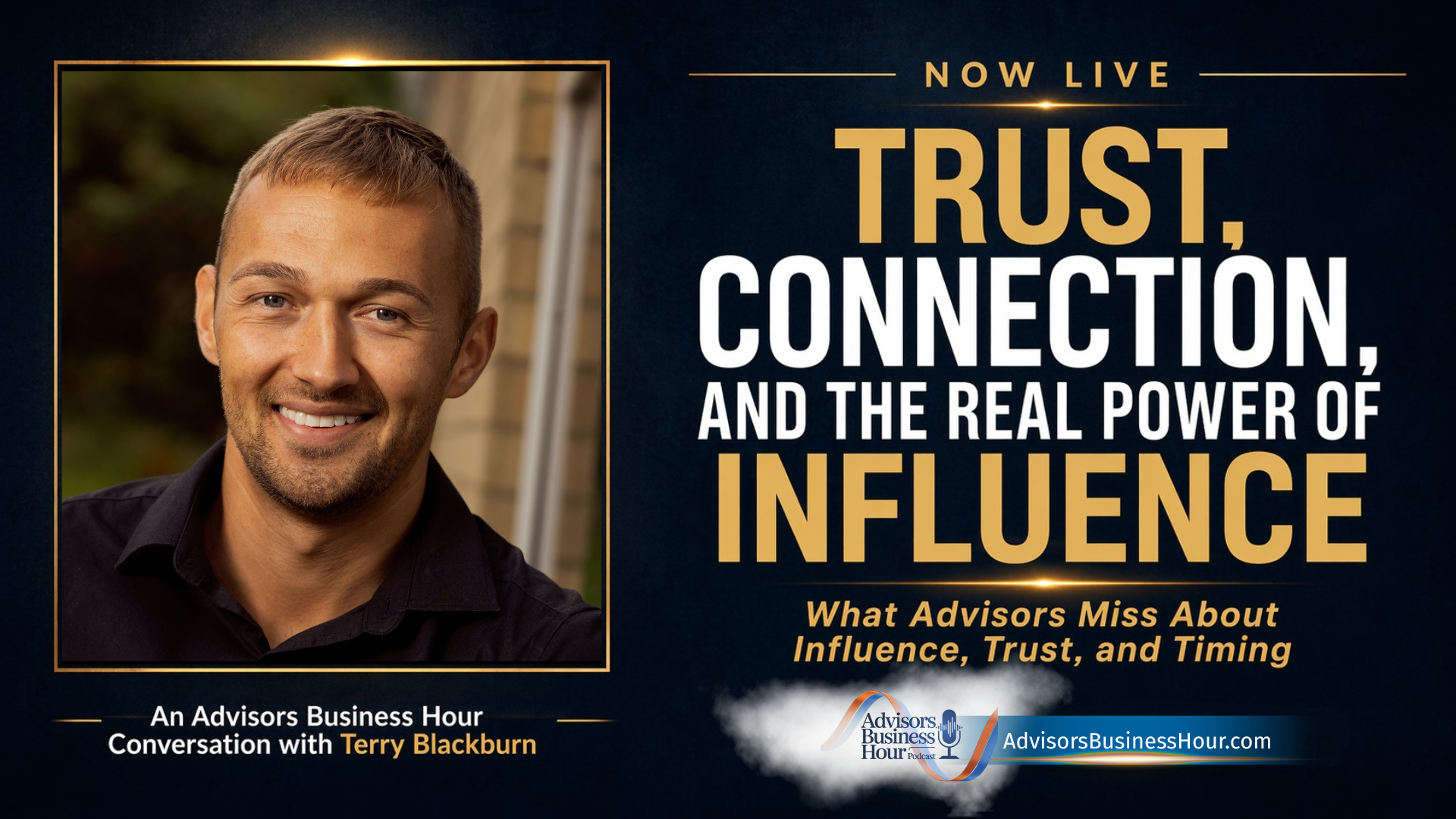
Terry Blackburn on the Advisors Business Hour
In this episode of The Advisors Business Hour, hosts Sherry Savber Johnson and Jeff Mount sit down with Terry Blackburn, founder of the Wealthy Advisors Club, to unpack what it really takes to succeed in financial services today.
From knocking on doors at 19 to building and exiting multimillion-pound brokerages, Terry shares a raw, practical, and deeply human perspective on selling life insurance—and why the best advisors aren’t just selling policies, but changing lives.
This conversation dives into the evolution of prospecting, the power of asking the right questions, and why empathy—not pressure—is the real driver of sales success.
Contact our special guest Terry Blackburn through the links below:
Website:https://
wealthyadviserclub.com/ Email: terry@terry-blackburn.com
Social links: https://uk.linkedin.com/in/
terry-blackburn-property & https://www.instagram.com/ terry_blackburn_official/
Get your copy of Terry’s new book, The Life Insurance Playbook, and companion workbook here:
https://www.amazon.co.uk/dp/
Packed with proven scripts, templates, and processes, this resource helps financial services professionals improve questioning, presentations, objection handling, follow-up, and closing. While it is especially powerful for life insurance sales, the insights apply to anyone who wants to communicate more effectively and influence with greater skill.
Why Terry Blackburn’s Journey Matters
Terry didn’t start with advantages—he started with rejection.
- Failed most subjects in school
- Began as a carpenter before pivoting careers
- Entered financial services at just 19 years old
- Built resilience through door-to-door sales in tough markets
That foundation shaped his philosophy:
sales isn’t about pushing products—it’s about solving real human problems.
The Evolution of Lead Generation
Terry explains that while technology has changed the game, fundamentals still matter.
Old School (Still Works)
- Referrals
- Strategic alliances (centers of influence)
- Relationship-based networking
New School (Now Essential)
- Social media (organic + paid)
- PPC campaigns
- AI-assisted prospecting
The takeaway:
There is no single “best” strategy—success comes from an omni-channel approach tailored to your strengths, time, and budget.
The Real Skill That Separates Top Advisors
According to Terry, the biggest difference between top performers and struggling advisors isn’t leads.
It’s questions.
Top advisors:
- Ask deeper, emotionally relevant questions
- Uncover problems clients don’t realize they have
- Guide conversations—not control them
Weak advisors:
- Ask surface-level or transactional questions
- Focus on price instead of value
- Try to “sell” instead of diagnose
Why Most Life Insurance Conversations Fail
Most advisors make the same mistake:
- “Would you like life insurance?”
- “How much coverage do you want?”
These questions don’t work because:
- Clients don’t understand the need yet
- They haven’t felt the emotional impact
- There’s no urgency or clarity
The Fix: Problem-Based Questioning
Instead, Terry teaches advisors to uncover reality:
- “If something happened to your partner, could you maintain your lifestyle?”
- “How long could you cover expenses without their income?”
- “What happens after that?”
This approach:
- Creates awareness
- Builds emotional connection
- Positions the advisor as a guide—not a salesperson
Why Empathy Drives More Sales
A key theme throughout the episode:
“If you lead with helping people, you will make more money anyway.”
When advisors focus on:
- Protecting families
- Creating financial security
- Preventing long-term hardship
They naturally:
- Close more deals
- Build trust faster
- Generate more referrals
From Transactions to Transformation
Terry highlights the deeper impact of life insurance:
Without coverage:
- Families may lose homes
- Children’s futures change
- Generational setbacks occur
With coverage:
- Stability is preserved
- Opportunities remain intact
- Entire family trajectories improve
This is why belief in the product matters.
Will AI Replace Advisors?
Short answer: not anytime soon.
AI can:
- Automate outreach
- Handle simple transactions
- Assist with data
But it cannot:
- Build trust
- Read emotional cues
- Create meaningful human connection
The future belongs to:
advisors who combine technology with authentic relationships.
Inside “The Life Insurance Playbook”
Terry’s book breaks down his full system, including:
- Lead generation strategies
- Scripts and frameworks
- Appointment-setting techniques
- Objection handling
- Follow-up systems
- High-performance sales habits
Most valuable section: “Killer Questions”
Because:
- Questions drive conversations
- Conversations drive trust
- Trust drives sales
Execution Over Information
Terry also introduces his 90-Day Performance Planner, designed to:
- Turn knowledge into action
- Break goals into daily KPIs
- Build consistent habits
Key idea:
Information alone doesn’t create success—implementation does.
Timestamps
- 00:00 – Introduction and Terry’s background
- 02:00 – From construction to financial services
- 05:00 – Door-to-door sales and resilience
- 06:00 – Lead generation: old vs new school
- 10:00 – The impact of life insurance
- 13:00 – Why helping people leads to more sales
- 15:00 – The power of asking the right questions
- 20:00 – Real client impact stories
- 23:00 – Tonality and communication skills
- 27:00 – AI vs human advisors
- 32:00 – The Life Insurance Playbook
- 34:00 – 90-day execution strategy
- 36:00 – Final thoughts and where to connect
Key Takeaways
- The best advisors ask better questions—not pitch harder
- Referrals and relationships remain the strongest lead sources
- Combining old and new strategies creates consistent growth
- Empathy and belief in your product drive long-term success
- AI won’t replace advisors—but it will replace average ones
- Execution—not knowledge—is what separates winners
Transcript
[00:00:00] Welcome back to the Advisors Business Hour where we dive into the heart and hustle of building your ideal advisory practice. I’m Sherry Sarber Johnson with Beneficial Business Solutions, and I’m here with my co-host Jeff Mount, president of Cadi, LLC, and he’s also the guy we like to call the advisor to.
[00:00:20] Advisors. Welcome to the show, Jeff. Sherry, always good to see you. Well, it’s good to see you. And today we have a special treat for our listeners. We have a gift joining us all the way from across the pond in the uk. He is founder and director of the Wealthy Advisors Club. Please welcome Terry Blackburn.
[00:00:42] Hi Sherry. Hi Jeff. How are you doing? We’re doing fantastic. Well, I’ll let Jeff speak for himself. Don’t wanna put words in your mouth. Terry, we’re so glad you’re here with us. We can’t wait to dive into your story. Thank you. Thank you for having me. It’s a pleasure. And, and thanks so much for joining us in the [00:01:00] middle of the day, our time, because we know it’s quite late for you.
[00:01:03] And, and that was very nice of you to do. Um, yeah, so it’s, it’s, it’s seven 30. The kids are just about to go to bed, so, um, if there’s any screaming or shouting, that’s just my four, uh, crazy children in the background. But they whole thing, bed too part of the background. Uh, on balance, right? Yeah. All right.
[00:01:22] Well, let’s just go ahead and dive into a little bit of your background, which I find personally very exciting. You’re, you know, you’re obviously a young guy still. You’re, uh, you know, you’re only in your thirties and you’ve really, and you’ve been in the business for over 16 years, so you really just kind of grew up in the business it sounds like.
[00:01:40] Yeah, so, so straight from school, you know, I did, I failed everything in school for, for context. Um, I was okay at maths. That was probably the only thing I was good at, but I failed everything else and straight from school, I was pushed into a trade in the uk that’s really common. I went to be a build on a building.
[00:01:58] You know, I was a carpenter [00:02:00] joiner, and I hated it. I hated every minute of it. These hands are far too soft to be a builder. Um, and I, I’d done that for a couple of years, but I absolutely hated it. And I just stumbled into financial services. I got offered a position for a company called Combined Insurance Company of America here in the uk.
[00:02:21] When I was 19, and honestly within two weeks I loved it. I sold my tools as a builder and I will, I said, I will never, ever go back to being a builder. This is what I want to do for the rest of my life. And that was 19, you know, 19 years of age. I’d just turned 19 and most of the company I was working in, you know, most of the advisors were 40 to 50 and older.
[00:02:46] Sure. Uhhuh, Uhhuh, and, and I was 19, but I looked probably. 13. I didn’t even have any stubble. I looked very, very young and And you guys know trying to sell [00:03:00] insurance, there’s nothing tangible. There’s not even a product to sell. Right? Right. And when I looked so young, I was then trying to speak to, it was called Calling by the way.
[00:03:10] Knocking on doors. Oh boy. And trying to, trying to sell people a concept that if them or their husband or the wife dies, that the children are gonna be okay. And these people were looking at me thinking, who is this young guy? What is he talking about? Yeah. What is he not? I’m in the door on my face. And I suppose without jumping too far ahead, I believe that gave me a really tough skin and a really good foundation of this industry because I’ve seen it at its hardest.
[00:03:38] So now it, , I don’t wanna say it’s easy ’cause that comes across the wrong way, but it’s a lot easier now than it, than knocking on doors that, that’s for sure. Using social media, using ai, using referrals, and various other strategies you can do now. It, it’s certainly a lot easier than it used to be.
[00:03:56] But, but yeah, to, to, to go back to your question, it, it, it’s been 16, [00:04:00] 17 years and I, I was really young when I started, but that’s put us in a great place. And it sounded like they started you really old school. I mean, knocking on doors, like what could be tougher than that. And the, the first area is a place up in northern England called Blythe, which is really, really like.
[00:04:21] Deprived unemployment through the floor. A lot of drugs. It’s a really not a nice area. My first area was ply, so I was literally threw in the deep end in the worst possible area, not during the day. We knocked on businesses, walked into shops in various places, and on the on, on the evening, on the night, were knocked on residential or on homes.
[00:04:44] And because I didn’t know any different and I was brand new to sales, brand new to the industry. I’d just done what I was told and the the people in charge of that business said, Terry, do this. Knock on these doors. See this script. When they see this, you see [00:05:00] that? And it was just. Even though it was really tough, I just loved it.
[00:05:05] I just for some reason loved it from day one. Um, it was certainly easier than using me hands, you know, in, in, in the freezing cold in England. Yeah. Yeah. I guess everything’s relative, but it’s, I love that story. That’s so cool. And it’s neat that you got started so young ’cause you really got to see.
[00:05:24] Kind of how the industry has evolved with technology and all the different changes that have really come about, you know, in the past 15, 20 years, um, you’ve been able to see kind of like the whole spectrum. Mm-hmm. So what do you feel has been the biggest boon to helping advisors attract business since you started?
[00:05:48] Knocking on doors. Yeah, knocking on doors. Well, I definitely wouldn’t recommend anybody knocks on doors. I, I think Gen Z would have a, a mini heart attack if, if a lot of them tried that anyway. Um, but yeah, [00:06:00] so I mean, I, in the Wealthy Advisor Club I teach, there’s 11 different lead generation strategies and I teach a combination of the old school and the new school.
[00:06:08] A lot of the old school definitely still works. A hundred percent. You know, Jeff’s done this a lot longer than me. I’m sure ge, Jeff can, can talk about a lot, a lot of those points. Really well. But for me, old school is referrals. Referrals will always still work. Will always work. The fantastic thing about those is they are warm leads.
[00:06:29] They’re typically quality leads. And if it’s a good introduction, it, it’s quite an easy sell because people buy under the influence of others. So, so referrals will always work. We call them in the UK introducers or strategic alliances, and that is somebody who can send you leads. So for example. An estate agent or real estate agent, you guys call them, we call them estate agents and letting agents in the uk, they are selling houses all the time.
[00:06:57] The mortgage business, the loans, as well as the insurance. [00:07:00] Mm-hmm. A company, a tax advisor, an accountant, somebody who’s got your clients, so. That’s just about setting up relationships. That old school stuff, again, will always work, but now certainly in the, in the past decade, social media has took a huge part of that organic socials as well, as well as paid socials.
[00:07:20] PPC is a big, big thing in the UK as well for mortgage and insurance business, so. People often ask me, you know, which is the best lead generation strategy? What should I do to grow my business, Terry, if I want to generate more leads? And the answer unfortunately, isn’t black and white. It’s not, definitely do this one and it’s definitely gonna work because it’s mm-hmm.
[00:07:44] It’s subjective. It depends upon the person, it depends upon their experience levels. It depends upon their skillset. It depends on how much capacity, how much time they can input into lead generation, as well as how much capital they’ve got. Because some of these [00:08:00] strategies do cost money. So I’ve seen old school and new school, and personally I recommend that people do a combination of the two that best meets their kind of skillset, strategy, and, and, and position.
[00:08:14] Really, if that, if that makes sense. Um, I’m sure Jeff can add some good stuff to that too. Yeah. You know, I, I, I completely agree with you. We talk on here, uh, often about an omni-channel approach, which is exactly what you’re saying is, um. Do as much as you can. You don’t always have the budget to do everything that you want.
[00:08:33] Mm-hmm. And in terms of, of getting referrals, we call ’em centers of influence. But it’s, it’s the same thing. Same thing. And you’re right, it’s accountants, attorneys, it’s property and casualty insurance agents. It’s, it’s wherever you can, you can find somebody who’s in front of people who need what you have on a consistent basis.
[00:08:53] Absolutely. Absolutely. And there’s loads, and sometimes you’ve just gotta think a little bit outside the box, haven’t you? Mm-hmm. And the, the good [00:09:00] thing about life insurance in particular is unfortunately everybody’s gonna die. And unless Elon Musk, you know, comes up with some mad chip that he puts in everybody’s heads, um, but unfortunately the death ratio is one to one.
[00:09:13] Mm-hmm. And the cancer ratio is one in two, it’s 50%. So ultimately there’s a hell of a lot of people that need. Insurance, right? Mm-hmm. Mm-hmm. It’s not like we are limited. It’s not like we’re selling, I dunno. Ferraris or fancy watches, there’s only a certain amount of people that can afford to do those or, or, or want, or need them.
[00:09:34] Right. This insurance thing is, is completely different. There’s so many people that need it. Yeah. So I thinking a little bit outside the box with strategic alliances, um, centers of influence for for sure is a great strategy. Yeah. You know, well, you’re, oh, go ahead. Sorry. Sorry. Go. No, you go ahead, uh, Jeff and, and, uh, I’ll go next.
[00:09:55] You know, we talk about how you have to have a thick skin to sell insurance and [00:10:00] how hard it is at a young age. I have no doubt that what kept you committed was seeing it actually work. Mm-hmm. And seeing how it, it inspired a family to, to, to carry on after someone passes away. Um, I, I think back to probably 15 years ago, I, I, I had a.
[00:10:21] Job of, of effectively explaining to senior management and one of the biggest insurers in the world based there in the uk, Prudential uk. And, and we had to explain the difference in distribution of financial services at the UK versus the us and it is quite different. Hmm. And then he started explaining, he goes, do you know what I do?
[00:10:40] I said, I, I, please tell me. He goes, I go to the far east and I go to some of the, the poorest areas of the far east. I mean, really, really? Tough spots to be in. And when I get there, I always have to tell the cash, excuse me, the registrar at the hotel. [00:11:00] Please don’t let anybody know I’m here and I’m gonna use a fake name, and here’s some cash.
[00:11:05] Please don’t tell them where I am. And sure enough, somebody come in and pay them even more and tell me where he is and, and what they were looking for was a job. Selling insurance because they understood that not only are they gonna make money that, which is hard to do in that area, but they were also going to make everybody in the community wealthier over time.
[00:11:28] Mm-hmm. So by writing insurance on everybody, it’s the old school industrial insurance where you go and you collect each week, uh, in, you know, the actual cash in hand to pay for the policy. Yeah. So kind of like what we did way back in the, you know, early 19 hundreds, um. He knew that he was partially responsible for the, the growth of that part of the country.
[00:11:53] And I mean, wow, how inspiring is that? Yeah, that’s such a great long-term [00:12:00] view of what you’re doing, how, you know, looking at changing whole communities. That’s amazing. Hey, Terry. You just put out a book, and this was one of the reasons why we wanted to bring you on the show called The Life Insurance Playbook, and I don’t wanna let you go without talking about that book because that was one of the main reasons that we wanted to pick your brain because literally that’s one of the best books that I’ve looked at in terms of selling.
[00:12:32] Philosophy systems and the whole gambit. And it really applies to so much more than just the life insurance industry. I could, I personally, believe anybody could gain a lot, regardless of what you may, what, what business you may be in by taking a look at your book. So tell us a little bit more about the juicy details of what’s included in the book, how you came about, you know, how it came about and all that stuff.
[00:12:59] [00:13:00] Yeah, absolutely. Just to reinforce what Jeff said as well be before I got onto the book, which is I completely agree, like I truly, truly believe this in my soul, that life insurance, like a lot of people get into it because you can make a lot of money and you can, but actually that there’s a much bigger and better byproduct, which is help ieg legitimately helping generations of families.
[00:13:25] And I know that sounds a bit cheesy. But it legitimately is, it’s, it’s literally the children’s children of your, of your clients, of your, your, your, your, you know, your customers can be helped. ’cause think about if they didn’t have insurance, and let’s say a husband dies. The wife is then left with the children.
[00:13:45] They’ve got one less income coming into the household. They meant might lose the property that they live in. They might have to move into a worse area. The children go into a worse school. The children then start to hang around with the wrong type of people. Then the [00:14:00] children go down the wrong path and then the children have children, they are born into the, it can literally, mm-hmm.
[00:14:07] Just by having a lump of money paid to that family, if something happened, the whole direction of that family tree almost changes. Right. And I, and I just want to reinforce what Jeff said there, because anybody who’s looking to sell more life insurance wants to sell more. You lead. If you lead with let’s make some more money, it won’t be as powerful and you certainly won’t do as well in my opinion.
[00:14:31] If you have the viewpoint of I’m legitimately helping people mm-hmm then you make more money anyway, but you are actually doing good by, by people. And if you lead with that and that, that’s what I’ve, you know, if you fast forward, I talked about when I was, when I first started, but if you fast forward to now, I built two of the largest brokerages in the uk.
[00:14:52] I’ve exited both of them about hundreds and hundreds of staff. Sold millions and millions of pounds worth of life insurance generated millions in commissions [00:15:00] and in everything that I’ve taught to other people and still teach Now is, is in this book. So it’s called the Life Insurance Playbook, which has got literally the systems, the full script, how to get referrals, is in there, what we talked about.
[00:15:15] It’s, but everything from when your client first approaches you. Or you get sent the lead, whether it’s a referral or it’s an internet lead or it’s a social media lead, what to say when you ring them up, how to get them into an appointment, how to get them in a, in the UK we call ’em fact finds, where you, you effectively, it’s a questionnaire.
[00:15:34] Mm-hmm. The questions in that questionnaire are the biggest differentiator, in my opinion of all. It’s the questions that you ask in that meeting. In that questionnaire that will sell life insurance or not? Because if you say to somebody, would you like life insurance? Nah, not really. Too expensive. Or they just think it’s a cost.
[00:15:58] Yeah. How much life [00:16:00] insurance would you like? It doesn’t work either. How long would you like your life insurance for? That definitely doesn’t work because the clients don’t know. We, as the advisors have to advise them and the, the best way to do this is ask them questions to uncover the problem. ’cause most of ’em have a problem.
[00:16:18] They just don’t know it. You uncover the problem and then you can present the solution that solves the problem. And the only way to identify that problem is questions. So, for example, you could say, so Sharif, if heaven forbid if your partner was to die, would you be able to stay in the same property that you live in now and have the same quality of life for you and your children?
[00:16:40] And they’re gonna say, well, probably not. Or, well for a li maybe. Okay. So out of interest, how long could you continue to pay your bills for if your, your husband or, or your, or your partner had had died? They might say, well, about about six months. Okay. So out of interest, what would happen after the six [00:17:00] months?
[00:17:01] Well, I’m not really sure. Okay. So what we can do here is we can put something in place that, heaven forbid if that does happen, that we can make sure that you get a lump of money if your partner dies and, and there’s a lot more to it. Right. But what, what I’m getting to there is you will then see and agree and believe that there is a problem prior to those questions you didn’t.
[00:17:23] Like people don’t have that thought process, do they? They don’t think about problem if my husband die. Think kind of programmed to not think about death. Yeah. And to not think about why, why would you want to? Scary scenario. Yeah. It’s like it’s a horrible thing, right? Yeah. Nobody has, nobody wakes up in the morning and thinks, right, today I’m gonna think about death and cancer.
[00:17:41] No, no. Nobody does that. Um, so, so my, my point is. The questions that you ask in the meeting, but that they’re, they’re all in there. How you close, how you deal with objections, how you follow up your client. The 15 fundamentals are becoming a high performance salesperson is what I teach, which is all in there.[00:18:00]
[00:18:00] Um, and it’s, it’s literally the, the, in the uk they’re already calling it the Bible of life insurance. It’s only been out a month and it, it’s all got quite a few hundred copies. I’ve just put everything that I know because I’m so passionate about Jeff’s point, which is, which is helping people. Mm-hmm. If I were just wanting to make money, I knew I could sell this for probably 10 times what I’m selling it for, and I could sell, I do sell.
[00:18:24] I’ve got a membership where I teach this in detail, but I could, my point is I could charge a lot more and, and I’ve lowered the barrier to entry because I want to help advisors sell more life insurance ultimately. That’s great. That’s, that’s, that’s the book anyway. I love what you said, Jeff, and I love what you said, Terry, about focusing on how you’re helping the client because that also informs what you suggest to people.
[00:18:51] And I love what you said, Terry, about how it’s not about selling more, but you will sell more. ’cause that’s the side effect of helping more people. And the side [00:19:00] effect of actually caring is absolutely that irony that you actually do better yourself. Hmm. You get more referrals, you get better testimonials and reviews.
[00:19:10] Mm-hmm. And I’m sure Jeff’s had this in his career, and I definitely have, which is when you get that phone call and one of your clients says to you, my wife’s died, my husband’s died, or I’ve got cancer, or, or had a heart attack. Or my wife husband’s in hospital and they say. Does, is that insurance gonna pay out?
[00:19:30] Like what, what, what do I have in place? Does that insurance cover that? And you look on your computer and you say, yes it does. What I’m gonna do is I’m gonna look at, I’m gonna ring the insurance company and, and help you with your claim. And then when you get an email you do in the UK when someone is paid out.
[00:19:46] You know, Mr. And Mrs such and such or or whoever is, is gonna get paid out X amount and you have to make that phone call and they start crying and they’re thanking you so much for, for what you’ve done for them. It [00:20:00] completely changes the way that you think about this industry. In my experience for sure.
[00:20:04] It makes the, the pain of the door knocking, metaphorically speaking a little, little less. Yeah. For for sure. For sure. And it, it comes across when you’re selling as well, because I mm-hmm. I just believe in it so much. ’cause I’ve seen so many claims paid out and how it helps people. It, they, like a lot of people say when they meet me that my energy’s infectious and, and my energy’s like this when I talk about life insurance because I’m so passionate.
[00:20:29] I’m so passionate about this. I, yeah. Um. But yeah. Anyway, , I,, well we could talk for a long time on this ’cause it’s so juicy. I was wondering, for folks that maybe wanna just like take a look at the book or you know, just to give some, a little bit more detail. Mm-hmm. What do you think, if you could just recommend one, I know, read the whole thing, right?
[00:20:50] Because it’s awesome. But what would be one section that you would say is, can’t miss this. Obviously, yeah. [00:21:00] Front to back, twice upside down, sideways, you know. But, um, but. From my teachings, ’cause I coach a lot of people as well. So a coach and mentor, like in the uk I I, I run the largest community in the UK for financial services professionals.
[00:21:16] I’ve got nearly 2000 members now, and it’s only been trading 11 months. It’s scaling really, really quickly. And I teach the things in this book live on, on Zoom every week. Um, we do big conferences where I teach them live and we do two day events where I teach it live. And from the book, from the live trainings, from the conferences, the, the sessions that get the most testimonials and the most positive feedback are.
[00:21:44] A section called killer Questions, which is again, kind of alluded to it already and touched on it, which is the questions that you ask in the meeting are literally everything. Mm-hmm. If you were a builder, a builder has tools, in his tool [00:22:00] belt is a life insurance salesperson, your questions are your tools that they are what makes, like in every organization, in every country, in every industry in sales, there’s leaderboards.
[00:22:13] There’s people at the top and people at the bottom often they have the same product, the same opportunity, the same. They’re often in the same location. They’re getting the same amount of leads or quality of leads or whatever. It’s not the leads, it, it’s what they, it’s what they say in the meetings that makes the biggest difference.
[00:22:34] Mm-hmm. Everybody at the top I’ve ever came across. Ask good questions. Mm-hmm. The aren’t scared of asking the hard questions or the uncomfortable questions. Having a conversation with a, with a client that, that they’re not scared of that, and, and they do it every time. The people at the bottom of the leaderboards ask poor quality questions like.
[00:22:54] How much life insurance would you like? Would you like to add life insurance onto your mortgage? Nobody [00:23:00] wants to add it on. Like they, they just ask poor quality questions. Yeah. And that is the biggest, the, the biggest thing that moves the needle the most is the question. So, uh, killer questions. There’s, there’s loads.
[00:23:12] I teach, uh, tonality. So how you use your tone of voice, ’cause that’s your super, that’s your secret weapon. Mm-hmm. It’s your superpower because. You can see words in a mono torn wheel like this, or you can see it. With the different tonality types of your voice, and that will determine how a client interprets your words.
[00:23:32] Mm-hmm. So you can ask good questions, but you, if you ask them in the right tone, they become more powerful. The right tonality, with the right cadence, the right pauses. Ultimately, if you ask them at the right, the right questions in the right way, at the right time, you will sell more life insurance than most people in, in your organization or industry.
[00:23:55] I’ve certainly found that here in the uk. Yeah. I’ve created and trained some of [00:24:00] the top guys who are still the top guys now who used to work for me. I trained them up in the, the Darren. Have you ever heard of, uh, Chris Voss? Yes. Yeah. Yeah. Um, split the difference. Never split the difference, right? Yeah. You talked about the tone of voice.
[00:24:14] He calls it thera, the late night radio DJ voice. Mm. He says if you, you, you, you slow it down, you tone it down, you kind of almost a little more than whisper, but not much. Mm-hmm. And, and people just. Listen in. They just, they can’t get enough. And of course, you know, uh, um, being able to recognize certain personalities and understanding the motivators, all that contributes to the success, no question.
[00:24:42] And I have, I have no doubt it’s a natural talent for someone like you and for those that the, the, the top of the leaderboard, but still can be learned by those at the bottom of the leaderboard. So, good for you. Well, something that we talk about on the show is the. Idea of connecting with folks [00:25:00] before you launch into, you know, the deeper details of Yeah.
[00:25:04] Of the sales process. Mm-hmm. And of course there every personality is gonna be slightly different, but there are patterns. And we did a show on that, which was kind of interesting. Well, really interesting. Jeff had some good stories, but, uh, while you were talking Terry, I was thinking those questions are great ways to connect.
[00:25:23] With, with the person, so you’re no longer metaphorically sitting across from them and this adversarial type of like, what are you gonna try to sell me and how am I gonna resist you to this guy really gets my situation. He’s gonna help, he’s gonna help me, you know, he is gonna help me figure out what to do, how to prevent, you know, this catastrophic.
[00:25:46] Situation that it happened. And uh, that is so important because so many times we see people just launch into a list or launch into something that just feels mechanical and they’ve lost that [00:26:00] golden opportunity to connect with the person. Hmm. And you’re completely right. And, and you know, life insurance isn’t like an off the shelf product and it’s not a one size fits all.
[00:26:11] Mm-hmm. You don’t just say he has a hundred grand, or he has 200 grand or half a million. Mm-hmm. Or what it’s, you have to ask the questions to determine what, like, you, like you said, to get to know the client so that you understand their full situation. You know, the liabilities, their assets, the, you need to know all of that before you can give any advice.
[00:26:31] You can’t just give. Random advice, you know that’s right for everybody because it’s not, it’s, it’s going to be tailored to the individual and, and you Right. That’s where, like in, in the UK there’s call centers. So these are people that just ring up, like call, call and they ring up clients randomly and they try to sell them a load of, you know, rubbish effectively that they, ’cause they’re not giving proper advice, they’re just trying to sell.
[00:26:57] Mm-hmm. On price. So they’re just selling the [00:27:00] cheapest. Oh, well you’ve got that one. I can beat it. Yeah. But often you get what you pay for and, and if this one’s cheaper than that one, there’s normally a reason. Yeah. And, and, and they aren’t getting to know the clients. They’re not asking good questions.
[00:27:12] They’re just trying to, they’re chasing money. Not, yeah, not looking after the clients. And I think that’s what you kinda get into, isn’t it? Getting to know your clients, asking good questions, building a relationship with them. Is is where, which I know we kind of talked about this, uh, briefly, Jeff, which was AI can’t really affect that.
[00:27:33] No. True AI can’t build relationships with people. You’re talking to two people who try to use AI to actually do the show. For us, it didn’t go well.
[00:27:47] I love it. It was so tempting though, because it was like, that’s gonna save us a lot of time. I be, I, I actually built, it’s a disaster, Terry. It, I, I built an AI sales person, right? And I was like, right, I want to teach it all [00:28:00] my tone of voice skills and my sales skills. Objection hat. And we trained this thing quite good.
[00:28:05] So I thought, right. I’m gonna test it. So I get various leads, people wanting to join my community online and things. So we set this AI out to, uh, bring some leads that we’ll have. And bear in mind, I’ve trained on my voice. It, it did sound pretty good. Uh, and any objections that people get, it was good. But people just know.
[00:28:26] Yeah, people feel it, they sense it. And yes, there’s the little, there’s that little pause that’s, you know, that’s what gives away. Yeah, definitely. But you can, you can shorten that quite a bit. So it’s, it is quite rapid, but I, I think. You just sense it, don’t you? Yeah. It’s one of those things that we just know.
[00:28:43] So a podcast, you just know, you know that it’s not really Jeff or Sherry, so you’re just like, uh, and of course there’s exceptions to every rule, and we’re saying this currently in 2026, who knows what’s to come, but um, [00:29:00] but yeah, yeah, yeah. Going back, building the relationships, I think. It’s where some salespeople will win and some businesses and organizations will win because if, if they have good salespeople who can build relationships, make phone calls, face-to-face meetings, zoom meetings, I think those are the advisors and the people that will win For sure.
[00:29:22] Um, in this digital world we’re going into. Yeah, it’s kind of good news in a way. To know that. You’re just unique, and nothing can really replace you. Yes. And if you’re good at connecting with folks and you’re, you’ve got your heart in the right place, you wanna help people, then you know, the really, the world is wide open.
[00:29:40] Totally. I was just gonna say that. Couldn’t agree more. Um, there are definitely some professions out there that will be challenged. Already are being challenged by ai. I’m not sure professional salespeople will be challenged by ai. Just it’s, they’re just not ever gonna be human enough. Hmm. [00:30:00] I agree. I, I think with like salespeople in no disrespect to any, any salespeople here, salespeople who sell it quite a low value or low perceived value product, which is kind of an off the shelf where the know that could just get it.
[00:30:16] The same anywhere. That’s not tailored, that’s not bespoke. That’s, that’s kind of just commodity. Yeah. You don’t need any advice. Yeah. Yeah, exactly. I think those will some mortgages to a degree, because if. In the uk, like we call it a vanilla case. A vanilla mortgage. A vanilla case is basically so easy and straightforward.
[00:30:39] Maybe it’s the first time buyers, they’ve got straightforward income, they’ve got no real debt or issues with credit, and they just wanna buy the first house and it’s, it is a low value house. It’s easy. That type of advice, like you can get robo advice that’s been able to do that for a couple of years.
[00:30:58] Sure. However, if, [00:31:00] if this guy is a, you know, a company director, he is got offshore income and it’s all, all over the place. He’s got multiple investments, she’s got loads of things going on. They’re wanting to buy multiple properties or a portfolio that then all of a sudden the robo advice isn’t applicable anymore.
[00:31:17] And would that person who’s got quite a bit of money maybe is the quite wealthy, would they really even want. A robo conversation? No, they’re probably one a person, don’t they? Um, and I personally believe the only other point of that I’ve got on this is my youngest child is three, so my youngest son is, is three, uh, of my four children.
[00:31:41] Would he. I’d be happy to take robo advice when he is our age. That’s a different, that’s a different conversation because he is gonna grow up with chat GBT. Right. And Gemini Inlaws. Right. And he’s not gonna know any different, we know different. So Right. Is, is, I mean, who knows? Nobody really, really knows.
[00:31:59] We [00:32:00] certainly think for the foreseeable future, um, professional salespeople, you said Jeff. I love that. Professional salespeople, especially in financial services, I think are relatively safe. I agree. Yep. Yeah. All right. Well, on that note, Terry, tell us again where we can find your book for those that don’t already have it, and, uh, give us a couple ways that we can connect with you online.
[00:32:27] Cool. No problem. So the Life Atunes Playbook by Terry Blackburn is on Amazon now. It’s, well, it’s 14 pounds in the uk. I’m not too sure what that is dollar wise, but, uh, but yeah, it’s, it’s cheap. Anyway, a couple of cups of coffee that, that’s all. But yeah, this is literally everything. I’ve, I’ve, 16, 17 years building two multimillion pound businesses is in here.
[00:32:51] I’ve also just released the 90 day performance Planner. Which is what it says on on the 10. It’s a 90 day planning booklet, so you plan [00:33:00] out your annual goals, you then break it down into quotas, into months, into weeks, and into days. And this is what I used to get my sales people to use. And this’ll, you set daily KPIs, you talk about your ideal outcomes for the day.
[00:33:13] It’s a really structured sort of booklet to work from every quarter, every 90 days. That’s the same price. It’s, it’s pennies. Um, that’s on our And when is that coming out? Is that out already? Depending on when this will be out, but it’ll be up 12th of, um, April. Oh, cool. So a, a week or so. So I imagine this is going to, that it’ll be live on Amazon before this.
[00:33:36] It’s, it’s live. It’s more help to, to take people from the knowledge that’s in the book to actually executing. No, that, that’s exactly why I’ve done it, because I talk about this a lot, which is there’s great information and you can get great information in loads of places. We just talked about ai, AI’s got so much information about everything, right?
[00:33:59] You, [00:34:00] there’s great information and then there’s implementation, which is what matters, and that’s what this is. This will help you implement what the, what this, what the book teaches. Um, and I still believe pen and paper, sometimes old school still works, getting a pen and paper every morning and writing down like, this is what I’m gonna do for the day.
[00:34:22] Yeah, this is my targets, this is how many sales I’m gonna make. And you set intention, you write it down, you’re putting it out there. You’re just a lot more likely to take the needed and relevant actions to achieve the goal so that, that they, they’re both on Amazon now. Very cool. Um, when this is released, or follow me on any, any social media, it’s just Terry Blackburn.
[00:34:43] Uh, you’ll find this in most places and the community that I run in the UK is called the Wealthy Advisors Club. Brilliant. So what is it about 90 Days, Sherry? You know, I have a 90 Day challenge as part of the Wisdom training program. So it’s same idea. It’s about taking all [00:35:00] training and implementing. Yeah.
[00:35:02] Well, I think there’s probably some, uh, science out there about how long it takes to go create a new habit, something new, create a new habit. Uh, something that Terry was saying, which I, I really like is the pen and paper. And there’s been studies done on it where, uh. There’s something about the physical, the three-dimensional habit of, writing something down that interacts with our brain in a different way than just playing digital Without a doubt.
[00:35:30] Yeah.
[00:35:33] So we can’t hear you, Terry. You need to take yourself off mute. Sorry guys. The, the children just ran in there. That’s okay. That’s okay. He was really cute. That was a treat. Yeah. I’m sorry that your listeners are not gonna be able to see. I’m very cute. I, I dunno where my wife’s got, my wife was about to be put them to bed, but I think she’s upstairs and he’s wrapped.
[00:35:51] Well, I think we’ve probably gone over time anyway, so, uh, we’ll let you go and get back to your family. Thank you so much, Terry, for joining us today. I know no [00:36:00] problem. That our listeners are gonna be excited to get that book and hopefully. They will, because I had a chance to take a look at it and, and it’s awesome.
[00:36:08] We appreciate you so much, your energy. Thank you. Your view on the industry, it’s so refreshing. Thank you. And best of luck. I can’t wait to see a number one in the, in the, uh, New York Times bestseller. Yes, absolutely. We’ll be, we’ll put up all the links as well on the page, on the website page when the, the episode is published.
[00:36:32] And yeah, I’d just like to end on it, like if anybody’s liked what I’ve talked about or, you know, you, you do sell life insurance yourself and, and you wanna learn from us, reach out. Honestly, I’m happy to help if you’ve got equal or you’ve got some form of passion for this industry. I’d love to connect with you and help in any way that I can, uh, because the more.
[00:36:50] The more people that, that believe this message and, and are part of this mission, like the more good we can do if, you know, for every country. [00:37:00] Right? Yeah. ’cause yeah, families need life insurance and, um, yeah. It’s a pleasure. Thank you both very much for your time. It’s, uh, it’s great to to chat with you.
[00:37:08] Thank you, Terry. Thank you, Jeff. Have a great day, guys. All right. Take care. Bye-bye. Thanks guys. Cheers.